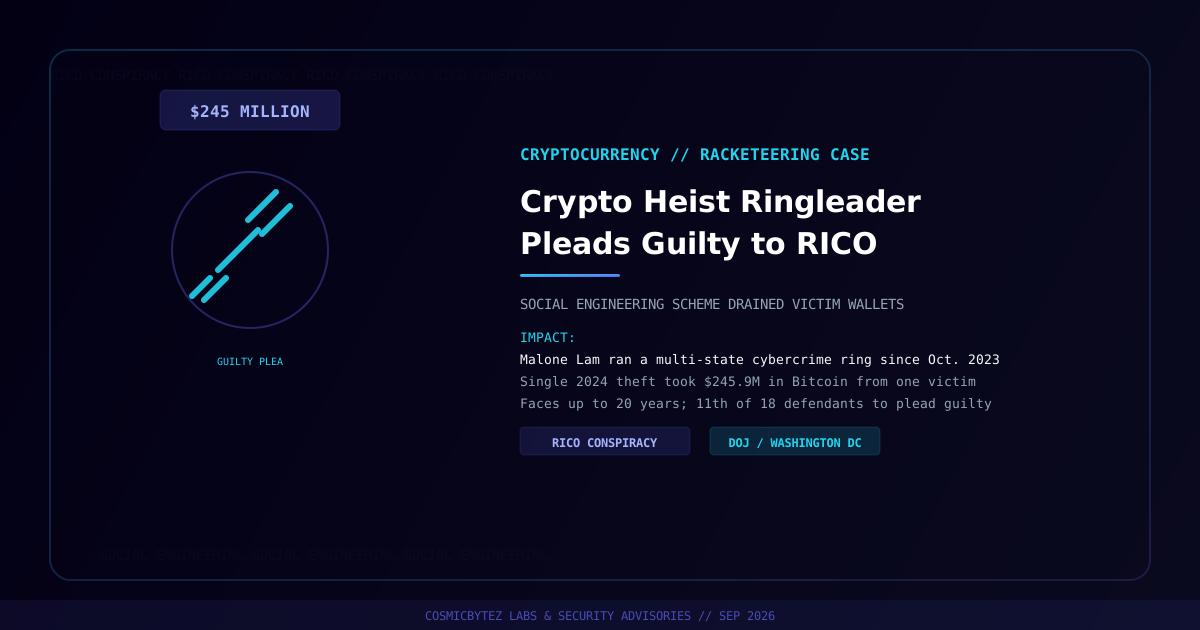
Malone Lam, a 22-year-old citizen of Singapore who had been living in Miami, pleaded guilty in U.S. District Court in Washington, D.C., to a single count of federal racketeering conspiracy (RICO) for his role as ringleader of an international cybercrime enterprise that used social engineering to steal and launder more than $245 million in cryptocurrency.
How the Scheme Worked
According to the U.S. Attorney's Office for the District of Columbia, Lam — who went by aliases including "Anne Hathaway," "$$$," and "King Greavy" — organized and directed the enterprise, identifying target victims and coordinating the roles of co-conspirators based in California, Connecticut, New York, Florida, and abroad. The group formed through connections made on online gaming platforms and operated from at least October 2023 through May 2025.
Rather than hacking wallets directly, the conspirators relied on social engineering: posing as tech support staff or exchange representatives, sending fake security alerts, and convincing victims to hand over their digital keys. In some cases the group escalated to home break-ins to obtain the information needed to drain a victim's holdings. Once access was secured, the group used remote-access tools such as AnyDesk to empty the wallets.
The single largest theft — $245,930,239 in Bitcoin taken from one victim in August 2024 — accounts for the bulk of the scheme's total haul.
Case at a Glance
| Detail | Value |
|---|---|
| Defendant | Malone Lam, 22 (Singapore / Miami) |
| Charge | Racketeering conspiracy (RICO), 1 count |
| Total stolen | $245M+ in cryptocurrency |
| Largest single theft | $245.9M in Bitcoin (August 2024) |
| Scheme timeline | October 2023 – May 2025 |
| Arrested | September 18, 2025, Miami |
| Co-defendants | 18 total charged; Lam is the 11th to plead guilty |
| Maximum sentence | 20 years |
Spending the Proceeds
Prosecutors say Lam and his co-conspirators spent the stolen funds on a lifestyle designed to draw attention rather than avoid it: nightclub tabs running close to $500,000 in a single evening, luxury handbags and watches, rental homes in Los Angeles, the Hamptons, and Miami, and more than 30 vehicles — including Ferraris, Lamborghinis, and customized Porsches, ranging in value from $100,000 to $3.8 million. Lam himself reportedly purchased a $2 million watch.
Legal Outcome
Lam faces a maximum of 20 years in prison under the RICO statute and could face deportation to Singapore following any sentence. U.S. District Judge Colleen Kollar-Kotelly did not immediately schedule a sentencing hearing; a status hearing has been set for December 8, 2026. Lam is the 11th of 18 charged defendants to plead guilty, marking a significant milestone in the Justice Department's investigation into the enterprise.
U.S. Attorney Jeanine Ferris Pirro said in a statement: "If you build a cybercrime empire, we will find you, dismantle your operation, and hold you accountable... This defendant led an international network that preyed on victims through deception, invaded their privacy, and stole hundreds of millions of dollars in cryptocurrency."
Why This Matters
This case is a reminder that the largest crypto thefts increasingly bypass smart-contract exploits and exchange hacks entirely in favor of targeting the human holding the keys. A single victim losing nearly $246 million to a social-engineering pretext — reinforced, in some cases, by a physical break-in — shows that high-net-worth crypto holders face a threat model closer to targeted fraud and home invasion than to traditional "hacking." Vigilance around unsolicited "security alert" contact from exchanges or wallet providers, combined with hardware-based key storage that can't be socially engineered away over a phone call, remains the most effective defense against this specific attack pattern.
References
- The Record — Scammer behind $245 million crypto heist pleads guilty to RICO charges
- U.S. Department of Justice — Singaporean Ringleader of $245 Million Cryptocurrency Racketeering Enterprise Pleads Guilty in Washington D.C.