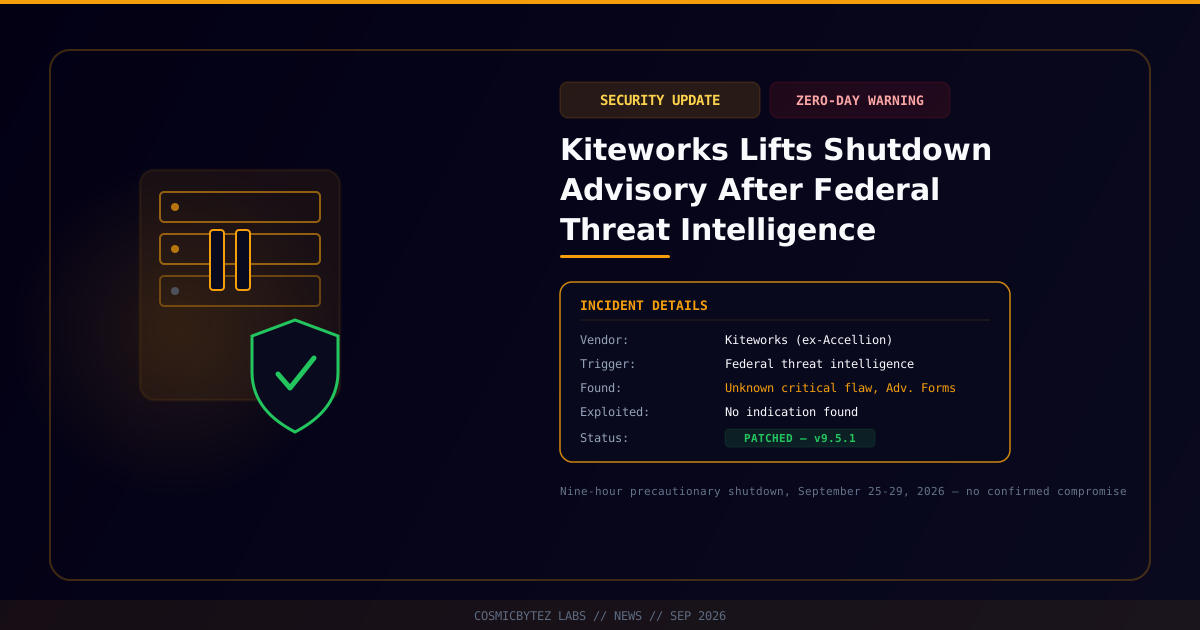
Kiteworks Lifts Precautionary Shutdown After Finding and Patching a Critical Flaw
Kiteworks, the secure file-transfer and managed file transfer (MFT) vendor formerly known as Accellion, has lifted a rare, company-wide precautionary shutdown advisory after telling customers it received "credible threat intelligence" from federal authorities warning that a threat actor might target its systems. The advisory went out on Friday, September 25, 2026, at 8:52 AM PDT, urging customers running self-managed deployments — on-premises, Azure, or AWS — to take their systems offline for a coordinated nine-hour precautionary window as the threat was investigated. During that shutdown, Kiteworks says it discovered and patched a previously unknown critical vulnerability in Advanced Forms, a secure data-collection capability used by fewer than 1% of its customer base (roughly 50 organizations). The company says it has "no indication the vulnerability was ever exploited" and restored normal operations over the weekend, with a public update confirming the all-clear on September 29, 2026.
| Attribute | Value |
|---|---|
| Vendor | Kiteworks (rebranded from Accellion in October 2021) |
| Product category | Secure file transfer / managed file transfer (MFT), file collaboration, email encryption |
| Trigger | "Credible threat intelligence" from unnamed federal authorities of a possible imminent attack |
| Advisory issued | Friday, September 25, 2026, 8:52 AM PDT |
| Shutdown scope | Self-managed customers (on-prem, Azure, AWS) — coordinated nine-hour precautionary window |
| Vulnerability found | Previously unknown critical flaw in Advanced Forms (secure data-collection tool) |
| Customers affected | Fewer than 1% of customer base (~50 organizations) |
| Other products | File collaboration, file transfer, email encryption, MFT — unaffected |
| Exploitation status | No indication of exploitation found |
| Fix | Deployed during the shutdown window; shipped in release 9.5.1 (September 29, 2026) |
| Federal agencies named | None confirmed — FBI declined comment; CISA declined to comment on record |
| Industry partner | Mandiant (threat intelligence sharing) |
Why Kiteworks Shut Down First
Kiteworks CISO Frank Balonis said the company received intelligence from "federal intelligence authorities" indicating a threat actor "may attempt to target some Kiteworks systems for customers," with the possibility of an attack materializing "as soon as this weekend." Rather than wait for confirmation of an actual breach, Kiteworks told its entire self-managed customer base — spanning healthcare, government, financial services, technology, education, and media — to shut systems down while it and "law enforcement partners work through the matter." Security researchers using internet-scanning tools identified roughly a thousand internet-facing Kiteworks systems at the time, illustrating the scale of exposure the advisory was meant to reduce, even accounting for likely overcounting in that figure.
Neither the FBI nor the Cybersecurity and Infrastructure Security Agency (CISA) confirmed involvement on the record when contacted by reporters, and Kiteworks itself has declined to name which federal agency supplied the tip or which threat actor prompted it. Analysts described the episode as unusual: it is common for CISA to publish advisories about a specific product vulnerability, but a federal intelligence agency privately warning a single commercial vendor of a targeted, imminent attack — with enough specificity that the vendor told its entire customer base to go dark — is not routine.
What Kiteworks Found During the Shutdown
While systems were down, Kiteworks engineering and security teams used the window to hunt for the flaw the warning implied. They found a previously unknown critical vulnerability in Advanced Forms, a secure data-collection feature enabled for a small subset of customers. Kiteworks says the company's core file transfer, file collaboration, email encryption, and MFT products were not affected. The company developed and deployed a fix during the outage window itself and also applied "an additional protective layer across all environments" as a defense-in-depth measure beyond the direct patch. No CVE identifier or CVSS score had been published for the flaw as of this writing. Researchers at Sophos separately indicated the original warning was tied to the possible exploitation of a zero-day vulnerability, though Kiteworks has not confirmed that the Advanced Forms flaw is the same issue referenced in the federal tip.
Why the Advisory Was Lifted
By Sunday, September 27, Kiteworks canceled the active shutdown guidance, and the company's public statement — issued September 28–29 — confirmed systems were restored to normal operation. CISO Balonis reiterated that the move was preventative: "We have no indication that Kiteworks or our customers' systems have been compromised, so this advisory is preventative rather than a response to a confirmed breach." CEO Jonathan Yaron defended the decision to act on an unconfirmed but credible warning rather than wait: "We would rather be proactive on credible warning than wait for certainty and be too late." Kiteworks says customers should be running the current release, 9.5.1, which contains the fix along with all previously known security updates.
Why This Matters
MFT and secure-file-sharing platforms sit at the center of the modern data-breach economy because they concentrate sensitive files from many customers in one internet-facing appliance. Kiteworks' own predecessor, Accellion, learned this the hard way: its legacy File Transfer Appliance (FTA) was mass-exploited in a December 2020–January 2021 zero-day campaign, compromising hundreds of organizations and fueling extortion by Clop-linked actors. That history repeated at industry scale with GoAnywhere MFT (Fortra, exploited by Clop in 2023) and MOVEit Transfer (Progress Software, exploited by Clop in 2023, one of the largest mass-exploitation events on record). Any story involving a "critical vulnerability" and a "file transfer" vendor in the same sentence draws immediate scrutiny given that lineage.
| Impact Area | Description |
|---|---|
| Direct impact | No confirmed compromise; Kiteworks reports no evidence the flaw was exploited before or during the shutdown |
| Operational disruption | Self-managed customers across healthcare, government, finance, technology, education, and media took systems offline for a coordinated nine-hour window |
| Sector precedent | MFT platforms (Accellion FTA, GoAnywhere, MOVEit) have a documented history as high-value mass-exploitation targets for ransomware and extortion actors |
| Transparency gap | Neither the specific federal agency, the threat actor, nor a CVE/CVSS score for the Advanced Forms flaw has been publicly disclosed |
| Trust signal | Proactive, industry-wide precautionary shutdown before confirmed exploitation is atypical vendor behavior and drew analyst attention as a possible new response model |
Recommendations
For Kiteworks Administrators
- Confirm all self-managed instances (on-premises, Azure, AWS) are running release 9.5.1 or later, which contains the Advanced Forms fix.
- If your organization uses the Advanced Forms capability, review recent form submissions and access logs for anomalies dating back several weeks, even though Kiteworks reports no evidence of exploitation.
- Verify the "additional protective layer" Kiteworks says it applied across all environments is active and has not been overridden by local configuration.
- Subscribe to Kiteworks' security advisory channel directly rather than relying on secondary reporting, given the company has not published a CVE for this issue.
For Security Teams
- Treat internet-facing MFT and secure file-sharing appliances as Tier 0 assets for monitoring purposes, given their repeated history as mass-exploitation entry points (Accellion, GoAnywhere, MOVEit).
- Reduce the internet-facing footprint of file-transfer appliances where possible; if roughly a thousand Kiteworks instances were discoverable via internet scanning, assume your own exposed MFT infrastructure is similarly enumerable by threat actors.
- Build an internal playbook for a precautionary shutdown response — this incident shows vendors may now ask customers to go dark on short notice ahead of confirmed exploitation, not after.
For Executives and Risk Owners
- Use this incident to pressure-test incident communication plans: could your organization execute a coordinated, multi-hour shutdown of a critical business system on a Friday morning with minimal advance notice?
- Request written confirmation from MFT and file-sharing vendors of their vulnerability disclosure timelines and CVE practices, particularly where "credible threat intelligence" claims are made without corroborating technical detail.
Key Takeaways
- Kiteworks issued a precautionary shutdown advisory on September 25, 2026 after receiving unconfirmed but "credible threat intelligence" from federal authorities about a possible imminent attack.
- During the resulting nine-hour shutdown window, Kiteworks discovered and patched a previously unknown critical vulnerability in Advanced Forms, affecting fewer than 1% of customers (~50 organizations).
- The company reports no indication the vulnerability was ever exploited, and the fix shipped in release 9.5.1 on September 29, 2026.
- Neither the FBI nor CISA confirmed involvement on the record, and Kiteworks has not named the specific agency, threat actor, or published a CVE/CVSS score for the flaw.
- Kiteworks is the rebranded successor to Accellion, whose legacy file transfer appliance was mass-exploited in 2020–2021 — part of a pattern that includes GoAnywhere MFT and MOVEit Transfer, making MFT platforms a recurring high-value target for extortion actors.
- Analysts flagged the episode as an atypical response model: a federal agency privately warning a single commercial vendor of an imminent targeted attack, prompting an industry-wide precautionary shutdown before any confirmed breach.
Sources
- CyberScoop: Kiteworks lifts shutdown advisory after 'credible threat intelligence' from federal authorities
- TechCrunch: Kiteworks urges customers to shut down their servers amid 'imminent' threat of cyberattack
- SecurityWeek: Kiteworks Urges Server Shutdown, Finds Advanced Forms Vulnerability
- Cybersecurity Dive: Kiteworks lifts advisory after precautionary warning for customers to shut down