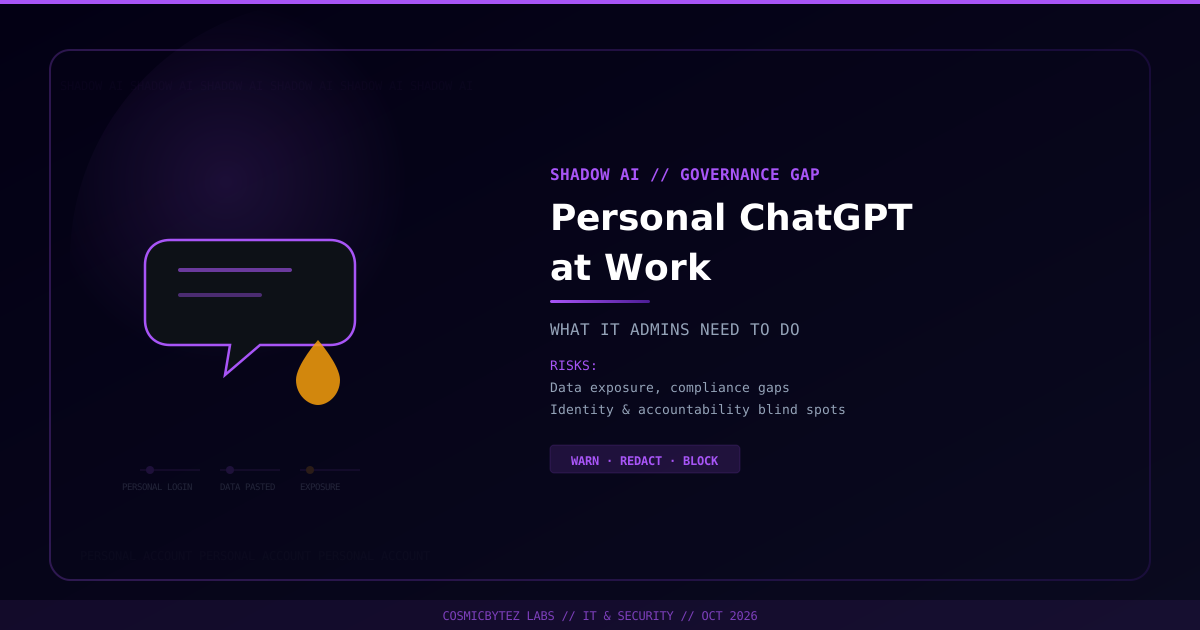
The Problem: Personal AI Accounts Don't Stop at the Login Screen
Even organizations that have rolled out an approved ChatGPT Enterprise workspace still run into employees quietly using their own personal ChatGPT accounts for work tasks. The habit is rarely malicious — it's usually convenience, a forgotten corporate login, or a workflow that predates the official tool — but it creates a governance blind spot that BleepingComputer, drawing on guidance from security vendor NordLayer, says IT teams need a concrete process to handle, not just a policy document that tells people not to do it.
Why Personal Accounts Are a Real Risk
| Risk | Why It Matters |
|---|---|
| Data exposure | Customer support tickets, account details, internal credentials, and other sensitive text get pasted into a service the organization has no contract, audit log, or data-handling agreement with. |
| Compliance violations | Regulated or government data reaching an external, personal-tier AI account can trigger reporting obligations and regulatory exposure — the article cites a 2025 incident involving a CISA director's personal account as a cautionary example. |
| Identity and accountability gaps | A personal login isn't tied to the corporate directory, so security logs can't reliably attribute what was shared, by whom, or when — undermining incident response from the start. |
None of this requires an attacker. The exposure happens the moment sensitive text is typed into a box the organization doesn't control.
NordLayer's Five-Step Response Framework
When an organization discovers unauthorized personal-AI use — whether through a DLP alert, an audit, or self-report — NordLayer recommends working through five steps in order:
- Confirm identity. Match the personal ChatGPT account to a specific employee using corporate email records and directory information, rather than acting on an anonymous or inferred match.
- Establish what was shared. Pin down exactly what data reached the service — a single question is a very different incident than a pasted customer record or a chunk of source code.
- Understand the cause. Investigate why the employee bypassed the approved corporate tool. Common root causes include expired SSO sessions, slow or flaky two-factor authentication, or simply not knowing an approved option existed.
- Assess impact. Scope the severity based on the sensitivity of the data type involved, and take proportionate action — this is not automatically a termination-level event.
- Prevent recurrence. Fix the underlying workflow friction that drove the behavior in the first place, and verify the employee can now reach the approved tool without obstacles.
The emphasis on root-causing why corporate access wasn't used (step 3) is the part most policies skip — punishing the workaround without fixing what made it necessary just pushes the behavior further underground.
Prompt-Level Controls
Beyond after-the-fact investigation, NordLayer's own tooling (and similar products from other vendors) illustrates a pattern IT teams are increasingly adopting: intercepting risky prompts before they leave the browser, with three escalating actions:
- Warn — alert the user and require confirmation before sending.
- Redact — automatically strip matched sensitive data patterns from the prompt.
- Block — prevent the submission entirely.
This kind of control sits alongside — not instead of — rolling out an approved, properly contracted enterprise AI workspace; a prompt-level filter without a sanctioned alternative just frustrates employees into finding another unmanaged tool.
Recommendations for IT Admins
- Audit before you police. Check whether employees actually have fast, frictionless access to the approved AI tool before assuming unauthorized use is a discipline problem.
- Treat corporate SSO friction as a security issue. Expired sessions and clunky 2FA flows are a documented driver of shadow AI use — fixing them is cheaper than cleaning up a leak.
- Deploy prompt-level DLP where feasible, using warn/redact/block controls rather than relying solely on acceptable-use policy language.
- Build the five-step response into your incident playbook now, before the first personal-account incident, so the investigation doesn't start from scratch under pressure.
Key Takeaways
- Personal ChatGPT use at work persists even after an approved Enterprise rollout, usually from convenience or access friction rather than malice.
- The core risks are data exposure, compliance violations, and an accountability gap created by logins outside the corporate directory.
- NordLayer's five-step framework — confirm identity, establish what was shared, understand the cause, assess impact, prevent recurrence — gives IT teams a repeatable response instead of an ad hoc one.
- Prompt-level warn/redact/block controls are emerging as a practical technical backstop alongside sanctioned enterprise AI tools, not a replacement for them.
Sources
- Employees using personal ChatGPT at work? Here's what IT admins need to do — BleepingComputer / NordLayer