AI Agents Get an Enterprise Control Plane
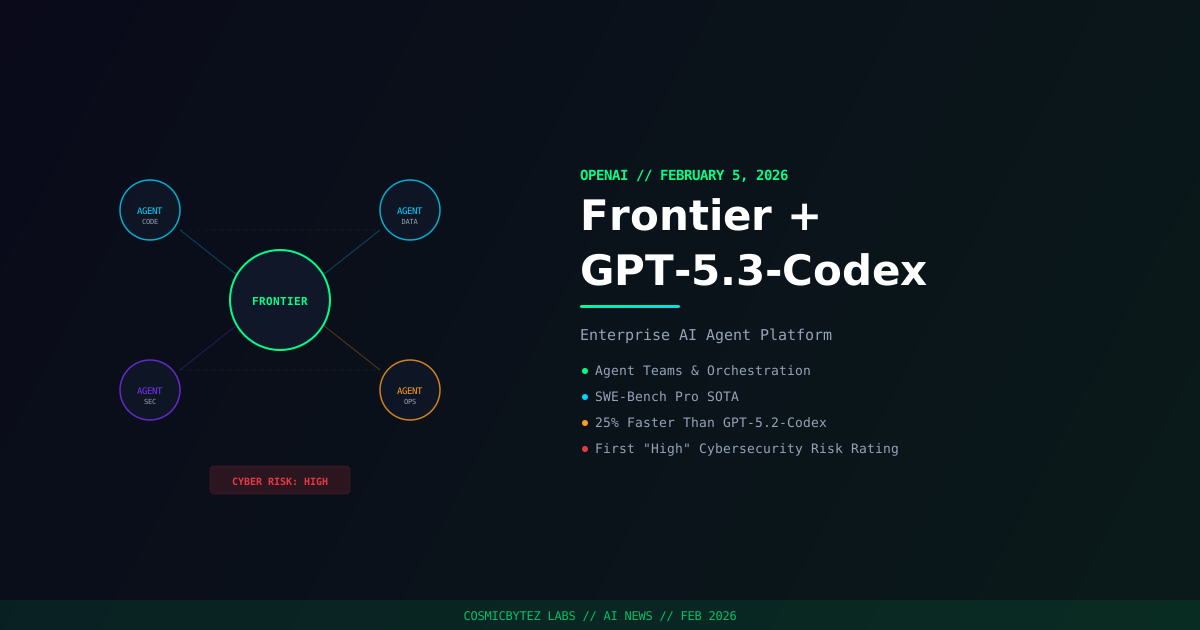
OpenAI has unveiled Frontier, a new enterprise platform designed to help companies build, deploy, and manage AI agents as operational workforce members. Alongside the platform, the company released GPT-5.3-Codex — its most capable agentic coding model and the first to receive a "high" cybersecurity risk rating under OpenAI's own preparedness framework.
Frontier: Agent Management at Scale
Frontier treats AI agents like employees, providing onboarding processes, feedback loops, and enterprise-grade identity and access management.
Core Capabilities
| Feature | Description |
|---|---|
| Agent Onboarding | Structured deployment workflows for new AI agents |
| Cross-Application Connectivity | Connects siloed internal apps, ticketing tools, and data warehouses |
| Multi-Vendor Support | Compatible with agents from OpenAI, Google, Microsoft, Anthropic, and custom-built |
| Enterprise IAM | Identity, access, and permission management for agent identities |
| Feedback Loops | Continuous improvement based on agent performance data |
| Audit Trail | Complete logging of agent actions for compliance |
Early Adopters
| Status | Organizations |
|---|---|
| Pilot customers | BBVA, Cisco, T-Mobile |
| Early access | HP, Intuit, Oracle, State Farm, Thermo Fisher, Uber |
| General availability | Rolling out over the next several months |
GPT-5.3-Codex: The Self-Improving Coder
GPT-5.3-Codex is OpenAI's most capable agentic coding model, designed specifically for autonomous software engineering tasks.
Performance
| Benchmark | Score | vs. GPT-5.2-Codex |
|---|---|---|
| SWE-Bench Pro | State-of-the-art | Improved |
| Terminal-Bench 2.0 | State-of-the-art | Improved |
| Speed | 25% faster | Baseline |
The Self-Bootstrapping Detail
In a notable milestone, GPT-5.3-Codex is the first AI model that was instrumental in creating itself. The Codex team used early versions of the model to debug its own training pipeline and manage deployment infrastructure. This represents a significant step toward self-improving AI systems.
Cybersecurity Risk Rating: "High"
OpenAI is deploying GPT-5.3-Codex with unusually tight controls — the first model to receive a "high" cybersecurity risk rating on the company's preparedness framework.
What This Means
| Risk Category | Concern |
|---|---|
| Autonomous exploitation | Model can identify and exploit software vulnerabilities with minimal guidance |
| Offensive tool generation | Capable of generating working exploit code for known CVEs |
| Social engineering assist | Can craft highly convincing phishing content tailored to specific targets |
| Evasion techniques | Understanding of security controls sufficient to suggest bypass methods |
Mitigation Controls
OpenAI stated the model ships with enhanced safety filters, rate limiting on security-related queries, and mandatory logging for enterprise deployments. The company emphasized that the "high" rating reflects the model's capability rather than demonstrated misuse.
What This Means for Security Teams
The Agent Security Challenge
As enterprises adopt platforms like Frontier, security teams face a new challenge: governing AI agents that act autonomously across business systems. Key concerns include:
- Agent identity management — How do you authenticate and authorize an AI agent?
- Blast radius containment — What happens when an agent makes an error at scale?
- Data access boundaries — Agents connecting to multiple systems create new data flow paths
- Audit and compliance — Agent actions must be traceable for regulatory requirements
- Supply chain risk — Multi-vendor agent support means trusting third-party AI models
This aligns directly with Gartner's 2026 cybersecurity trends report, which identifies agentic AI oversight as the #1 trend reshaping cybersecurity this year.
The Dual-Use Reality
GPT-5.3-Codex's cybersecurity risk rating highlights the accelerating dual-use nature of frontier AI models. The same capabilities that make the model excellent at finding and fixing bugs also make it capable of finding and exploiting vulnerabilities. This tension will define AI governance debates throughout 2026.