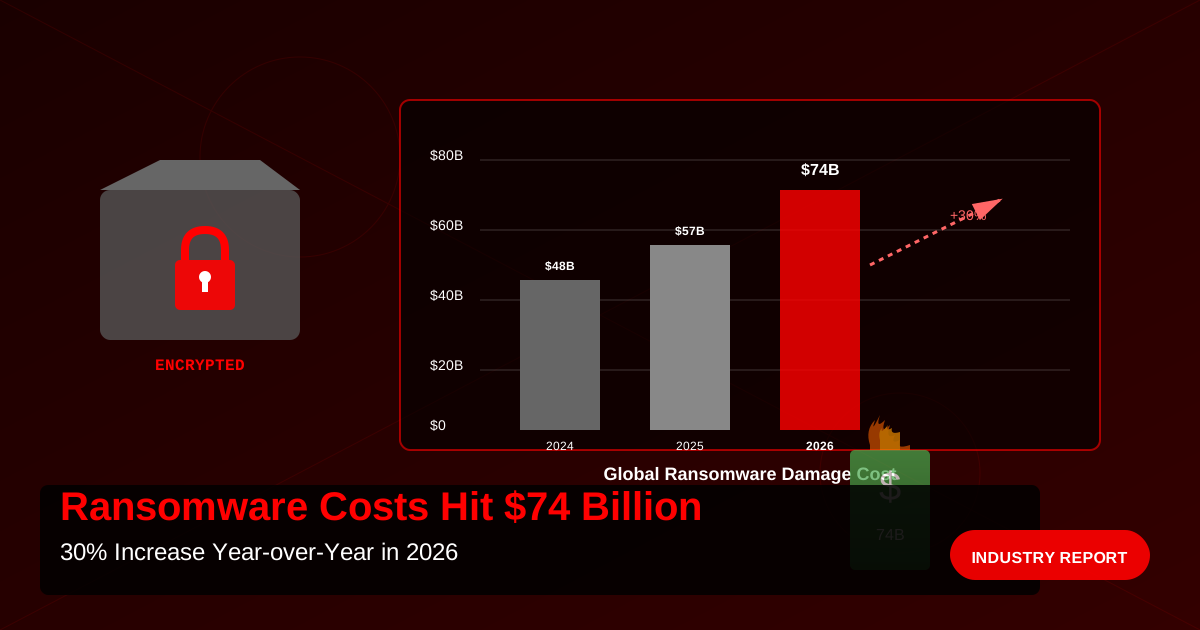
Ransomware Damage Costs Surge 30%
Cybersecurity Ventures has released its 2026 ransomware forecast, predicting that global ransomware damage costs will increase by 30 percent—from $57 billion in 2025 to $74 billion in 2026.
This staggering increase represents the continuation of a multi-year trend where ransomware has evolved from a nuisance to one of the most significant cyber threats facing organizations worldwide.
Breaking Down the $74 Billion
What's Included in "Damage Costs"
The $74 billion figure encompasses more than just ransom payments:
| Cost Category | Estimated % | Description |
|---|---|---|
| Downtime | 40% | Lost productivity, halted operations |
| Recovery | 25% | Incident response, system restoration |
| Ransom Payments | 15% | Actual payments to attackers |
| Legal/Compliance | 10% | Lawsuits, regulatory fines, legal fees |
| Reputation | 10% | Customer loss, brand damage, stock impact |
Real-World Impact
Average costs per incident (2026 estimates):
- Small Business: $150,000 - $500,000
- Mid-Market: $1M - $10M
- Enterprise: $10M - $50M+
- Critical Infrastructure: $50M - $500M+
Key Drivers of the 30% Increase
1. Ransomware-as-a-Service (RaaS) Proliferation
The RaaS model has democratized cybercrime:
Leading RaaS Platforms (2026):
- LockBit 4.0 (rebranded after takedowns)
- BlackCat/ALPHV (evolved variants)
- Royal Ransomware
- Play Ransomware
- Akira Ransomware
Why RaaS Accelerates Growth:
Traditional Model:
  Skilled hacker → Custom malware → Target selection → Attack

RaaS Model:
  Platform provider → Turnkey solution → Affiliates → Mass attacks
2. Double and Triple Extortion
Modern ransomware groups use multiple pressure tactics:
Single Extortion (legacy):
- Encrypt data → Demand ransom for decryption key
Double Extortion (current standard):
- Encrypt data → Exfiltrate sensitive data → Threaten publication → Demand ransom
Triple Extortion (emerging):
- Encrypt + Exfiltrate + Contact customers/partners/regulators → Multiple ransom demands
Quadruple Extortion (2026):
- All of above + DDoS attacks → Maximum pressure
3. Targeting Critical Infrastructure
Attackers increasingly target high-value, critical sectors:
Most Targeted Sectors (2026):
- Healthcare: $12B in damages (hospitals, medical devices)
- Financial Services: $11B (banks, payment processors)
- Manufacturing: $9B (supply chain disruption)
- Energy/Utilities: $8B (power grids, pipelines)
- Government: $7B (municipal, state, federal)
Why Critical Infrastructure?:
- ✅ Higher urgency to restore operations
- ✅ Greater willingness to pay
- ✅ Significant downstream impact
- ✅ Regulatory pressure to minimize downtime
4. AI-Enhanced Attack Techniques
Ransomware groups are leveraging AI to:
- Reconnaissance: Automated network mapping and vulnerability scanning
- Phishing: AI-generated spear-phishing emails with higher success rates
- Lateral Movement: Intelligent pathfinding to critical systems
- Data Analysis: Identifying most valuable data to exfiltrate
- Negotiation: AI chatbots for ransom negotiations
Geographic Distribution
Regions Most Affected
| Region | Estimated Damage | % of Total |
|---|---|---|
| North America | $28B | 38% |
| Europe | $21B | 28% |
| Asia-Pacific | $17B | 23% |
| Latin America | $5B | 7% |
| Middle East/Africa | $3B | 4% |
Notable Country-Specific Trends
- United States: $22B (highest absolute cost)
- United Kingdom: $4.5B (high per-capita impact)
- Germany: $3.8B (manufacturing sector heavily targeted)
- Australia: $2.2B (critical infrastructure focus)
- Canada: $2.1B (healthcare system attacks)
Ransomware Group Evolution
Top Threat Actors (2026)
By revenue generated:
- LockBit 4.0: ~$120M+ in ransom payments
- BlackCat/ALPHV: ~$95M+
- Play Ransomware: ~$80M+
- Royal: ~$70M+
- Akira: ~$65M+
Tactical Innovations
New techniques observed in 2026:
- Living-off-the-land (LotL): Using legitimate tools to evade detection
- ESXi targeting: Encrypting entire virtual infrastructures
- Backup destruction: Wiping all backup systems before encryption
- Data poisoning: Corrupting backups with malware before encryption
- Time-delayed encryption: Activating weeks after initial compromise
The Payment Dilemma
Should Organizations Pay?
Arguments Against Paying:
- ❌ Funds criminal organizations
- ❌ No guarantee of data recovery
- ❌ May violate sanctions (OFAC regulations)
- ❌ Encourages future attacks
- ❌ Data may still be leaked/sold
Arguments For Paying (controversial):
- ✅ Faster recovery in some cases
- ✅ May be only option without backups
- ✅ Critical services must be restored immediately
- ✅ Potential legal liability for data breaches
Payment Statistics (2026)
- 55% of organizations paid ransoms (down from 61% in 2025)
- Average ransom demand: $2.3M (up 45% from 2025)
- Average ransom paid: $850K (organizations rarely pay full amount)
- Data recovery success: 65% received working decryption keys
- Complete data deletion: Only 8% confirmed attackers deleted exfiltrated data
Defense Strategies That Work
Technical Controls
1. Immutable Backups
# 3-2-1-1 Rule
3 copies of data
2 different storage media
1 offsite/cloud backup
1 immutable/air-gapped copy2. Network Segmentation
Critical Assets Tier 0 (Crown Jewels)
    ↓ Restricted access
Business Systems Tier 1
    ↓ Controlled access
User Workstations Tier 2
    ↓ Limited access
Guest/IoT Tier 3
3. Endpoint Detection and Response (EDR)
- Behavioral analysis for ransomware indicators
- Automated isolation of infected endpoints
- Rollback capabilities for encrypted files
4. Email Security
- AI-powered phishing detection
- Link sandboxing and analysis
- Attachment detonation chambers
- DMARC/SPF/DKIM enforcement
Organizational Measures
✅ Incident Response Plan: Tested quarterly with tabletop exercises ✅ Cyber Insurance: Coverage for ransom, recovery, legal costs ✅ Security Awareness: Regular phishing simulations and training ✅ Patch Management: Automated patching within 48 hours of release ✅ Access Controls: Zero-trust, MFA, least-privilege everywhere ✅ Vulnerability Management: Continuous scanning and remediation
Emerging Trends to Watch
1. Ransomware Regulation
Governments are considering:
- Mandatory reporting of ransomware payments
- Restrictions on ransom payments (similar to terrorism financing laws)
- Liability frameworks for organizations with inadequate security
- Cyber insurance requirements for minimum security standards
2. Law Enforcement Action
Recent successes:
- LockBit infrastructure disruptions (ongoing)
- Arrests of RaaS operators and affiliates
- Seizure of cryptocurrency wallets
- International cooperation (Europol, FBI, NCA)
Challenges:
- Attackers operate from adversarial nations
- Cryptocurrency complicates fund tracing
- Rapid infrastructure rebuilding
- Decentralized affiliate models
3. Technical Countermeasures
Innovation in defense:
- AI-powered ransomware detection
- Decoy file systems (honeypots)
- Automated backup verification
- Blockchain-based audit trails
- Zero-trust architecture adoption
5-Year Forecast (2026-2030)
Cybersecurity Ventures projects continued growth:
| Year | Projected Cost | % Increase |
|---|---|---|
| 2026 | $74B | 30% |
| 2027 | $92B | 24% |
| 2028 | $110B | 20% |
| 2029 | $130B | 18% |
| 2030 | $150B | 15% |
Cumulative damage 2026-2030: $556 billion
Recommendations by Organization Size
Small Business (under 100 employees)
Priority investments:
- Cloud-based backup solution with versioning
- Business email protection (anti-phishing)
- Managed detection and response (MDR) service
- Cyber insurance policy
- Annual security awareness training
Estimated cost: $15K-$50K/year
Mid-Market (100-1,000 employees)
Additional requirements:
- 24/7 Security Operations Center (SOC)
- EDR on all endpoints
- Network segmentation
- Vulnerability management program
- Incident response retainer
Estimated cost: $150K-$500K/year
Enterprise (1,000+ employees)
Comprehensive program:
- Full security stack (SIEM, SOAR, EDR, NDR)
- Internal SOC with threat intelligence
- Red team/purple team exercises
- Zero-trust architecture implementation
- Dedicated incident response team
Estimated cost: $2M-$20M+/year
Conclusion
The projected 30% increase in ransomware damage costs to $74 billion in 2026 underscores the urgent need for organizations of all sizes to prioritize cybersecurity investments. Ransomware is no longer just an IT problem—it's a business continuity, financial, legal, and reputational risk that requires board-level attention.
The good news: Organizations that implement comprehensive security programs can significantly reduce their risk. The investments required are a fraction of the potential damage costs.
The bad news: Ransomware groups continue to innovate faster than many organizations can adapt. The threat will likely get worse before it gets better.
Bottom line: The question is no longer "if" but "when" your organization will face a ransomware incident. Preparation is everything.