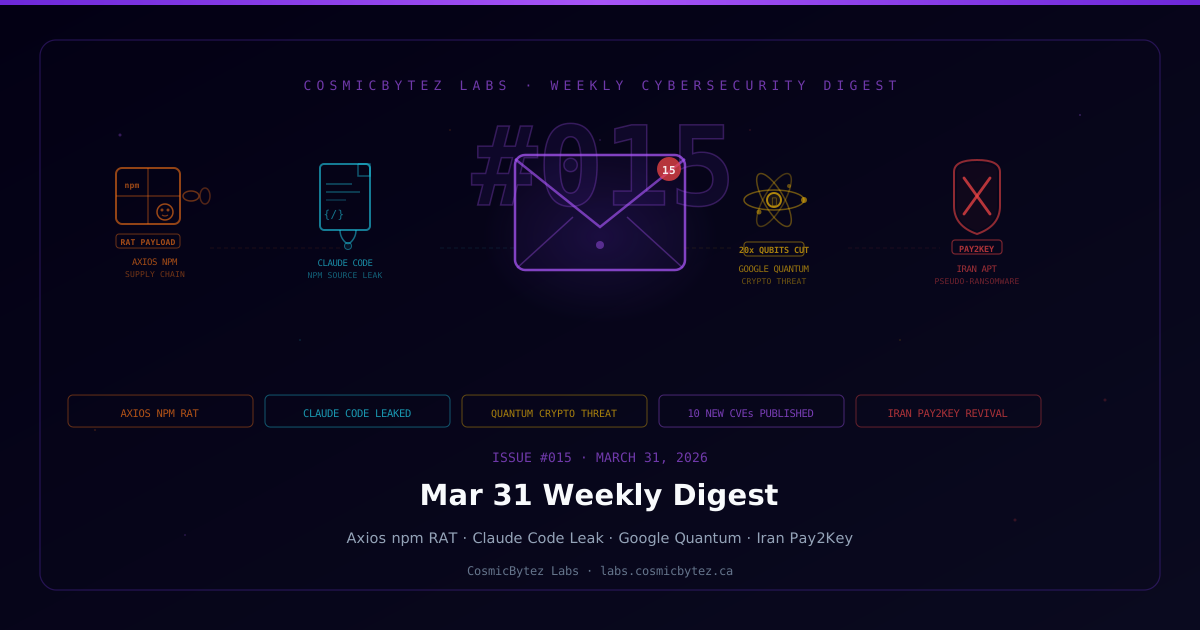
This Week in Cybersecurity
The final week of March 2026 closed with an exceptionally dense cluster of software supply chain incidents, AI tooling security failures, nation-state cyber operations, and a landmark quantum computing development with long-range implications for cryptographic infrastructure.
The npm ecosystem was shaken by two major security events within hours of each other. The widely-used Axios HTTP client library — downloaded over 50 million times per week — was compromised through a hijacked developer account, publishing versions 1.14.1 and 0.30.4 that silently deliver a cross-platform Remote Access Trojan via a malicious fake dependency. Any developer or CI/CD pipeline that installed either version should treat the environment as fully compromised and rotate all secrets immediately. Simultaneously, Anthropic disclosed it had accidentally published the Claude Code CLI source code — normally closed-source — inside an npm package tarball. No customer data or credentials were exposed, but proprietary agent loop logic, tool dispatch code, and permission handling architecture are now publicly visible.
On the threat intelligence front, Google's quantum research team published findings showing that breaking the elliptic curve cryptography securing Bitcoin and Ethereum requires roughly 20 times fewer qubits than previous estimates, driven by improved Shor's algorithm implementations. Current hardware is still far from capable — but the direction of travel matters and compresses the post-quantum migration window.
Iranian APT groups have revived the Pay2Key operation with updated tooling and expanded targeting, deploying pseudo-ransomware — destructive data wipers dressed as extortion tools — against US and Israeli organizations across defense, healthcare, critical infrastructure, and financial services. A ransom demand does not mean a criminal actor; it may mean a nation-state.
Top Stories
Axios npm Supply Chain Attack Delivers Cross-Platform RAT
Two newly published versions of the Axios JavaScript HTTP client — v1.14.1 and v0.30.4 — were pushed to the npm registry through a compromised developer account, injecting a fake dependency (plain-crypto-js@4.2.1) that delivers a cross-platform Remote Access Trojan. Axios is one of npm's most-downloaded packages, embedded in millions of JavaScript and Node.js projects and in virtually every CI/CD pipeline running JavaScript workloads.
The RAT payload targets environment variable exfiltration — capturing AWS_ACCESS_KEY_ID, GITHUB_TOKEN, NPM_TOKEN, and other secrets stored in build environments — as well as remote shell access, file system traversal, and persistence. CI/CD pipelines that ran npm install against a lockfile pinned to either compromised version may have delivered the RAT to build runners with access to cloud credentials and deployment keys.
Immediate actions: check your axios version (npm ls axios), upgrade to axios@1.14.0 or axios@latest, audit node_modules for plain-crypto-js, and treat any environment that touched either version as compromised. Rotate all accessible secrets without delay.
Claude Code Source Code Accidentally Leaked in npm Package
Anthropic confirmed it accidentally included the Claude Code CLI source code — normally proprietary and closed-source — in a published npm package. The leaked code covers the agent loop logic that governs how Claude Code reads files, writes code, and executes commands; tool definitions and permission handling; session management; and context window handling.
Anthropic confirmed that no customer data, API keys, model weights, or credentials were exposed and moved quickly to pull the affected package version. The likely root cause: an overly permissive files field or absent .npmignore in the build configuration silently included the src/ directory in the published tarball — a well-understood npm gotcha that npm pack --dry-run can catch before publish.
The immediate risk to Claude Code users is low, but the source exposure means researchers and threat actors can now map the CLI's file access patterns, tool dispatch logic, and trust assumptions to craft targeted prompt injection attacks or behavioral exploits calibrated to known code paths. No action required for current users; keep using official signed releases.
Google Slashes Quantum Requirements for Breaking Cryptocurrency Encryption
Google's quantum research team published findings demonstrating that breaking the elliptic curve digital signature algorithm (ECDSA) — the cryptographic foundation of Bitcoin, Ethereum, and most other major cryptocurrencies — requires approximately 20 times fewer qubits than previously estimated. The reduction stems from improved Shor's algorithm implementations for elliptic curves, reduced error correction overhead, and more efficient modular arithmetic on quantum hardware.
Today's quantum hardware is nowhere near capable of executing this attack — current processors operate in the hundreds of noisy physical qubit range, while the revised estimates still require thousands of logical qubits. Existing cryptocurrency holdings are not at immediate risk. However, the consistent trend of algorithmic efficiency improvements means the window for post-quantum migration is shorter than previously assumed, and blockchain protocols require years of community consensus to migrate cryptographic primitives.
For enterprise security teams: begin auditing ECC-dependent systems (TLS, SSH, code signing, PKI) and piloting NIST PQC standards (CRYSTALS-Kyber, CRYSTALS-Dilithium) now. For crypto custodians: any wallet address that has sent a transaction has had its public key exposed on-chain — monitor protocol governance discussions about post-quantum transitions closely.
Iran Revives Pay2Key with Pseudo-Ransomware Targeting US and Israeli Organizations
Iranian APT groups — including infrastructure attributed to Fox Kitten — have revived the Pay2Key operation with updated tooling and expanded targeting to include US organizations alongside Israeli victims. The campaign deploys pseudo-ransomware: malware that presents ransom demands but has no functional decryption capability, operating as a wiper designed to permanently destroy data under the cover of a criminal extortion narrative.
The tactic provides Iranian state actors with plausible deniability — a ransomware incident is initially handled through criminal investigation channels rather than the coordinated government response triggered by confirmed nation-state attribution. Targeted sectors include defense contractors, critical infrastructure, financial services, and healthcare. Initial access relies heavily on exploitation of VPN and edge device vulnerabilities in Citrix, Fortinet, and Ivanti products, combined with password spraying against Microsoft 365 and Exchange portals.
Key defensive insight: a ransomware note does not confirm a criminal actor. If your organization is in a high-risk sector, treat any destructive ransomware incident as a potential nation-state intrusion until attribution is established. Prioritize immutable and offline backups, pre-ransomware TTP detection (VSS deletion, bulk network enumeration, backup system access), and immediate patching of all edge devices.
F5 BIG-IP APM Flaw Reclassified from DoS to RCE Under Active Exploitation
CVE-2025-53521, initially disclosed in October 2025 as a high-severity denial-of-service flaw in F5 BIG-IP APM, has been reclassified as a remote code execution vulnerability and confirmed under active exploitation. Deeper reverse engineering revealed the underlying memory flaw is exploitable for controlled writes or arbitrary code execution — not merely service disruption. CISA added the updated RCE classification to the Known Exploited Vulnerabilities catalog and federal civilian agencies face a binding patching deadline.
BIG-IP APM manages SSL VPN, identity-aware proxying, and access policy enforcement at the enterprise network edge. Successful exploitation enables session hijacking, network access control bypass, and lateral movement from a highly privileged gateway position — making it a prime target for ransomware initial access brokers and nation-state intrusion operators. Organizations that applied the original October 2025 DoS patch should verify that patch covers the RCE vector and apply any updated hotfix.
Security Corner
10 CVEs are newly published to the Security Advisories section this week. Key advisories to action:
CVE-2026-32714 — SciTokens KeyCache SQL Injection (CVSS 9.8 Critical)
A critical SQL injection in the SciTokens Python library's KeyCache class allows attackers to inject arbitrary SQL through unsanitized str.format() calls using attacker-controlled issuer and key_id JWT claim values. The vulnerable code path executes before authentication is confirmed, requires no credentials, and enables authentication bypass, key material exfiltration, and database corruption. All versions prior to 1.9.6 are affected. Upgrade immediately: pip install --upgrade scitokens. The fix replaces string interpolation with parameterized queries.
Full advisory →
CVE-2026-5128 — Full advisory →
CVE-2026-31946 — Full advisory →
CVE-2026-32987 — Full advisory →
CVE-2026-32975 — Full advisory →
CVE-2026-32973 — Full advisory →
Also published this week:
- CVE-2026-2370 → Advisory →
- CVE-2026-4176 → Advisory →
- CVE-2025-15379 → Advisory →
- CVE-2025-15036 → Advisory →
Quick Takes
-
CISA Orders Feds to Patch Citrix NetScaler by Thursday: CISA added an actively exploited Citrix NetScaler memory flaw to the Known Exploited Vulnerabilities catalog with an aggressive federal remediation deadline. Citrix NetScaler vulnerabilities have a consistent track record of rapid threat actor weaponization — treat this as a priority patch regardless of FCEB status. Read more →
-
Dutch Finance Ministry Takes Treasury Banking Portal Offline After Breach: The Dutch Finance Ministry took its treasury banking portal offline following a confirmed breach, disrupting government financial operations. The incident highlights the continued targeting of national financial infrastructure. Read more →
-
CareCloud Discloses Patient Data Theft: Healthcare technology firm CareCloud informed the SEC of a potential patient data leak and subsequently confirmed that hackers stole patient records. The incident follows a pattern of healthcare sector targeting by financially motivated threat actors exploiting healthcare vendors with broad data access across multiple practices. Read more →
-
New Criminal Service Monetizing Ransomware-Stolen Data: A newly identified underground service is offering to monetize data stolen by ransomware gangs — adding a secondary revenue stream for affiliates and increasing financial pressure on victims regardless of whether they pay the original ransom demand. Read more →
-
Stolen Credentials Fuel Ransomware, BEC, and Nation-State Intrusions: New threat intelligence documents how credential theft — through phishing, infostealer malware, and underground markets selling breach data — is the single common thread linking ransomware operations, business email compromise, and nation-state intrusion campaigns at scale. Read more →
-
Cisco Source Code Stolen in Trivy-Linked Dev Environment Breach: Cisco confirmed source code was stolen following a breach of a developer environment, with the attack linked to a compromised Trivy security scanning integration in a CI/CD pipeline. The incident underscores the risk of security tooling itself becoming an attack vector. Read more →
Upcoming
-
April Patch Tuesday (April 14): Microsoft's next scheduled patch cycle lands mid-April. Begin pre-patch readiness reviews now, particularly for Windows, Exchange, Office, and Edge components — Q1 2026 has seen an elevated volume of RCE disclosures across the Microsoft stack.
-
npm Supply Chain Vigilance: Back-to-back npm incidents this week — the Axios RAT and the Claude Code source leak — are a signal to review dependency pinning, lockfile enforcement, and supply chain monitoring. Implement
npm ciin all CI/CD pipelines (nevernpm install), adoptnpm pack --dry-runas a pre-publish gate, and consider Socket.dev, Snyk, or Semgrep Supply Chain to catch suspicious package versions before they reach production. -
Post-Quantum Migration Planning: Google's revised qubit estimates reinforce that planning should begin now. Audit ECC-dependent infrastructure (TLS certificates, SSH keys, code signing certificates), pilot NIST PQC algorithms (CRYSTALS-Kyber for key encapsulation, CRYSTALS-Dilithium for signatures) in non-critical systems, and ensure cryptographic agility in your architecture so algorithm swaps don't require full rewrites.
-
Citrix NetScaler — CISA KEV Deadline: The actively exploited Citrix NetScaler flaw carries an imminent federal patching deadline. Non-federal organizations should use the same deadline as a best-practice target — NetScaler vulnerabilities are historically weaponized within days of public disclosure.
-
F5 BIG-IP — Active Exploitation Ongoing: With CVE-2025-53521 confirmed as RCE and in CISA KEV, all BIG-IP APM deployments should be patched by now. If not, this is an emergency. Review APM logs for anomalous activity back to October 2025 — the original disclosure date — for signs of prior compromise before the RCE potential became public.
By the Numbers
| Metric | Value |
|---|---|
| Axios weekly npm downloads (approx.) | 50M+ |
| Compromised Axios versions | 1.14.1, 0.30.4 |
| Malicious dependency injected | plain-crypto-js@4.2.1 |
| Google qubit requirement reduction | 20× |
| Iranian APT operation revived | Pay2Key (est. 2020) |
| F5 BIG-IP reclassification | DoS (7.x) → RCE (9.8) |
| State Dept. reward for Iranian hacker info | $10 million |
| Crypto stolen in Uranium exchange hack | $53 million |
| New CVEs published this week | 10 |
| Critical CVEs (CVSS ≥ 9.0) | 3+ |
CosmicBytez Labs — IT & Cybersecurity Intelligence Hub