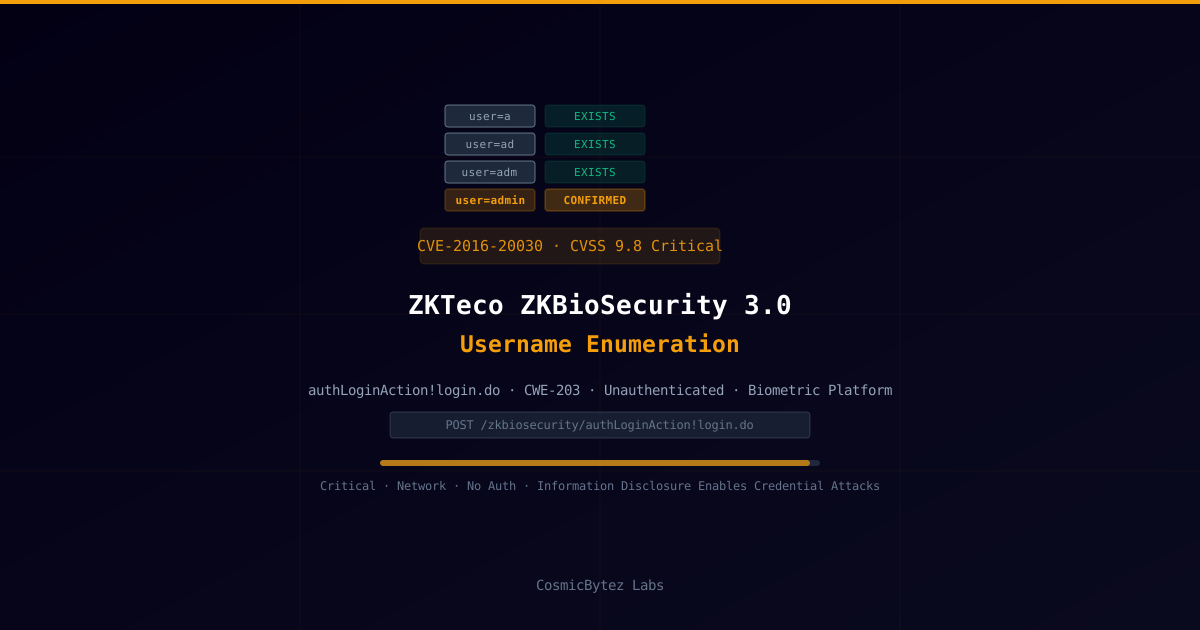
CVE-2016-20030: ZKBioSecurity 3.0 Login Endpoint Leaks Valid Usernames
A user enumeration vulnerability has been formally published to the NIST National Vulnerability Database for ZKTeco ZKBioSecurity 3.0, tracked as CVE-2016-20030 (CVSS 9.8, Critical). The vulnerability exists in the authLoginAction!login.do script, which processes login requests and returns differentiated responses depending on whether a submitted (partial) username exists in the system. This allows unauthenticated remote attackers to systematically discover valid usernames on a ZKBioSecurity deployment.
This CVE was published to the NVD on March 16, 2026. The high CVSS score reflects the combination of zero-authentication exploitation and the critical role ZKBioSecurity plays in physical access control infrastructure.
Vulnerability Overview
| Attribute | Value |
|---|---|
| CVE ID | CVE-2016-20030 |
| CVSS Score | 9.8 (Critical) |
| CWE Classification | CWE-203 — Observable Discrepancy / CWE-200 — Information Exposure |
| Affected Product | ZKTeco ZKBioSecurity 3.0 |
| Attack Vector | Network — no local access required |
| Privileges Required | None |
| User Interaction | None |
| Authentication | Not required |
| Patch Available | See vendor guidance |
Technical Background
ZKBioSecurity 3.0 is ZKTeco's centralized physical security management platform, handling biometric enrollment, access rule management, and attendance recording for thousands of organizations globally. The platform is built on Java/Struts web architecture, and the login endpoint authLoginAction!login.do is the primary authentication entry point.
The vulnerability arises from the application's failure to implement uniform responses for all authentication failure conditions. When a request is submitted with a partial or complete username:
- If the username exists in the database, the application returns a distinct response (different error message, HTTP response timing, or response body content)
- If the username does not exist, the application returns a different response
This behavioral difference allows an attacker to binary-search the username space with partial strings, iterating through character combinations to reconstruct valid usernames without ever successfully authenticating.
Attack Flow
1. Attacker identifies ZKBioSecurity 3.0 web interface endpoint:
   http://target:80/zkbiosecurity/authLoginAction!login.do

2. Attacker sends POST requests with varying username fragments:
   POST /zkbiosecurity/authLoginAction!login.do
   Content-Type: application/x-www-form-urlencoded

   username=a&password=wrong

3. Application responds differently for 'a' (exists as prefix) vs
   'z' (no match) — attacker records the response delta

4. Attacker iterates through character space, narrowing down to
   valid username prefixes using binary search or wordlist:
   username=ad  → valid prefix (different response)
   username=adm → valid prefix
   username=admi → valid prefix
   username=admin → VALID USERNAME (confirmed)

5. With valid usernames collected, attacker proceeds to:
   - Password spraying attacks against confirmed accounts
   - Credential stuffing from breached password databases
   - Social engineering targeting named employees
- Chaining with CVE-2016-20026 (hardcoded Tomcat creds) for RCESeverity Context
A CVSS 9.8 score for a user enumeration vulnerability warrants explanation. The NVD score reflects the environmental context of ZKBioSecurity deployments:
- Physical security criticality: ZKBioSecurity controls physical access to facilities — compromising accounts can unlock doors, disable alarms, or grant physical access to restricted areas
- Biometric data sensitivity: Identified usernames can be correlated with biometric enrollment data (fingerprints, facial scans) that cannot be changed like passwords
- Chained exploitation: Username enumeration directly enables targeted credential attacks; combined with the hardcoded Tomcat credentials (CVE-2016-20026), a full system compromise becomes trivial
- No authentication required: Zero barrier to exploitation from the network
Chained Attack Scenario
CVE-2016-20030 is most dangerous when combined with other vulnerabilities in the same product:
Step 1 (CVE-2016-20030): Enumerate valid ZKBioSecurity usernames
   → Collect: admin, jsmith, facilities_manager, security_admin

Step 2: Password spray enumerated accounts
   → Try common passwords, previous breach data, corporate naming conventions

Step 3: If Step 2 fails — pivot to CVE-2016-20026
   → Authenticate to bundled Tomcat Manager with hardcoded credentials
   → Deploy malicious WAR for RCE
   → Extract ZKBioSecurity database contents (all user hashes + biometric data)

Step 4: Use extracted hashes for offline cracking
   → Crack weak passwords for ZKBioSecurity accounts
→ Authenticate as admin, modify access control rulesRemediation
Primary Fix
Upgrade to a patched version of ZKBioSecurity that implements uniform login responses. Contact ZKTeco referencing CVE-2016-20030.
Immediate Mitigation
1. Implement generic error responses (requires application modification):
All authentication failure conditions — invalid username, invalid password, locked account — should return identical HTTP responses with no observable difference in:
- Response body
- HTTP status code
- Response headers
- Response timing (ensure consistent processing time)
2. Rate-limit the login endpoint:
Deploy a WAF or reverse proxy with rate limiting on the authentication endpoint:
# Nginx rate limiting for ZKBioSecurity login endpoint
limit_req_zone $binary_remote_addr zone=zkbio_login:10m rate=5r/m;

location /zkbiosecurity/authLoginAction!login.do {
    limit_req zone=zkbio_login burst=3 nodelay;
    proxy_pass http://zkbiosecurity_backend;
}3. Block external access to the authentication endpoint:
# Allow login only from internal management networks
# Deny all other access at the firewall or reverse proxy level
iptables -A INPUT -p tcp --dport 80 -s 192.168.0.0/16 -j ACCEPT
iptables -A INPUT -p tcp --dport 80 -j DROP4. Enable account lockout:
Configure ZKBioSecurity to lock accounts after a threshold of failed login attempts, reducing the effectiveness of credential stuffing following enumeration.
Detection
Monitor for enumeration patterns in ZKBioSecurity web logs:
# Identify rapid sequential login attempts from single IPs
# in ZKBioSecurity access logs

# Linux — Apache/Nginx log
grep "authLoginAction!login.do" /var/log/nginx/access.log |
  awk '{print $1}' | sort | uniq -c | sort -rn | head -20

# Windows — look for failed POST requests to the login endpoint
findstr "authLoginAction!login.do" "C:\ZKBioSecurity\logs\access_log.*"A high volume of POST requests to authLoginAction!login.do from a single IP — especially with sequential or alphabetical username patterns — indicates an active enumeration attempt.
Impact Assessment
| Impact Area | Description |
|---|---|
| Username Disclosure | Full enumeration of all valid ZKBioSecurity user accounts |
| Credential Attacks | Enables targeted password spraying and credential stuffing |
| Biometric Correlation | Usernames can be matched to biometric enrollment records |
| Physical Security Risk | Compromised accounts can modify access control rules for physical facilities |
| Chain Exploitation | Enables targeted use of hardcoded Tomcat credentials (CVE-2016-20026) |
| Exploitation Barrier | Zero — unauthenticated, requires only network access to the login page |
Key Takeaways
- CVE-2016-20030 allows unauthenticated enumeration of valid ZKBioSecurity 3.0 user accounts via differential login responses
- CVSS 9.8 (Critical) — reflects the physical security impact and zero authentication requirement
- Immediate mitigation: Rate-limit the login endpoint, restrict access to internal networks, monitor for enumeration patterns
- Chain risk: This vulnerability pairs with CVE-2016-20026 (hardcoded Tomcat credentials) to enable complete system compromise
- ZKBioSecurity controls physical access — account compromise has real-world facility security implications