CVE-2023-54342: Eclipse Equinox OSGi Console Remote Code Execution
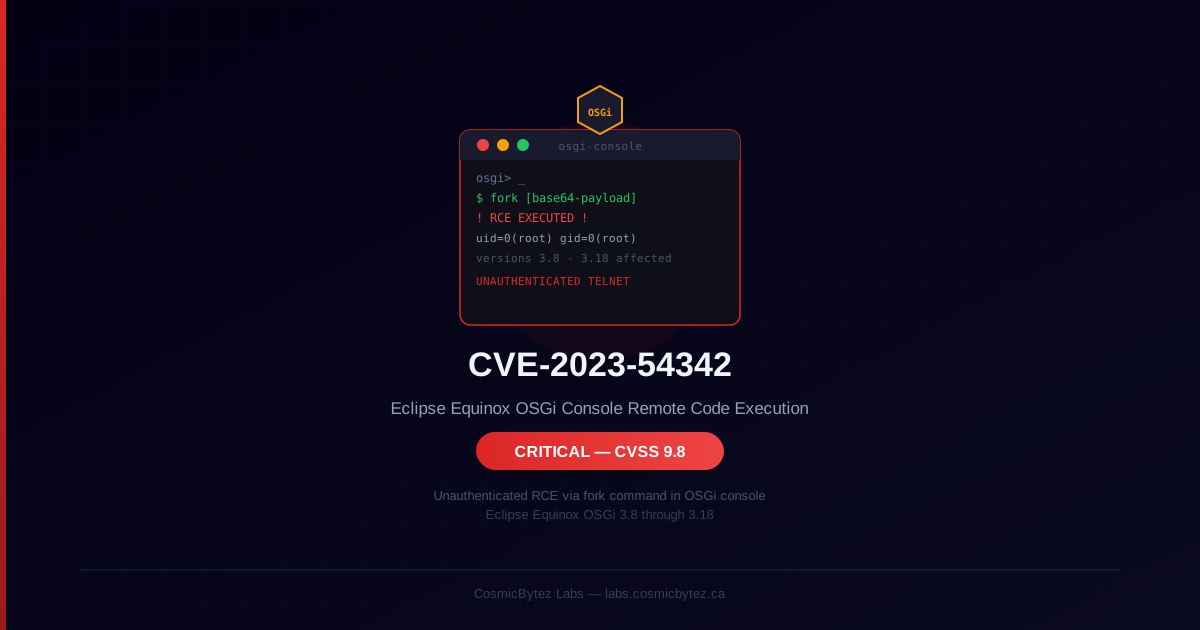
Eclipse Equinox has been assigned CVE-2023-54342 (CVSS 9.8, Critical), a remote code execution vulnerability in the OSGi console interface present in versions 3.8 through 3.18. The flaw allows unauthenticated remote attackers to execute arbitrary commands on the host system by connecting to the OSGi console's telnet port and exploiting the fork command functionality.
Eclipse Equinox is the reference implementation of the OSGi framework specification and is embedded across a wide range of enterprise Java applications, application servers, and development tools — including Eclipse IDE itself. The OSGi console provides runtime introspection and management capabilities, but when exposed and unprotected, it becomes a critical attack surface.
Vulnerability Overview
| Attribute | Value |
|---|---|
| CVE ID | CVE-2023-54342 |
| CVSS Score | 9.8 (Critical) |
| CVSS Vector | CVSS:3.1/AV:N/AC:L/PR:N/UI:N/S:U/C:H/I:H/A:H |
| CWE Classification | CWE-78 — Improper Neutralization of Special Elements in OS Commands |
| Affected Software | Eclipse Equinox OSGi 3.8 through 3.18 |
| Attack Vector | Network — telnet to exposed OSGi console port |
| Authentication Required | None |
| Scope | Unchanged — host system command execution |
| Published | 2026-05-05 (NVD) |
Technical Analysis
OSGi Console Telnet Interface
Eclipse Equinox exposes a management console that can be accessed over telnet when the framework is launched with the appropriate configuration. This console allows runtime inspection of OSGi bundles, lifecycle management, and framework introspection.
The console accepts a set of built-in commands, including the fork command, which is intended to launch external processes from within the framework. In versions 3.8 through 3.18, the fork command fails to properly sanitize attacker-controlled input. An unauthenticated attacker who can reach the console port can exploit this to execute arbitrary OS-level commands:
# Attacker establishes a telnet connection to the OSGi console
telnet target-host 7777

# Sends a base64-encoded reverse shell via the fork command
osgi> fork [base64-encoded-bash-payload]

# Result: arbitrary command execution as the process ownerThe attack requires network access to the console port. By default, OSGi console ports are not authenticated and may be bound to externally reachable interfaces depending on deployment configuration.
Exploitation Path
- Reconnaissance: Identify exposed OSGi console telnet ports (default: 7777) using network scanners
- Connection: Establish a telnet session — no credentials required
- Payload Delivery: Send a crafted
forkcommand with a base64-encoded OS command payload - Code Execution: Equinox executes the command as the Java process owner — typically a service account
If the JVM process runs as root or a privileged user, the attacker gains full system compromise.
Affected Deployments
Eclipse Equinox 3.8 through 3.18 is embedded in a broad range of software:
| Product | Risk |
|---|---|
| Eclipse IDE (all editions using affected Equinox) | High if console is enabled |
| Eclipse-based application servers (e.g., Virgo, Gemini) | High |
| Custom OSGi-based Java enterprise applications | High |
| Jenkins (if backed by an OSGi launcher) | Conditional |
| Apache Felix (separate implementation) | Not directly affected |
Deployments where the OSGi console port is not exposed to the network are not directly vulnerable via this vector, but should still upgrade to address any secondary exploitation paths.
Impact Assessment
| Impact Area | Description |
|---|---|
| Remote Code Execution | Arbitrary OS commands executed as the JVM process owner |
| Complete Host Compromise | If the JVM runs as root, full system takeover is possible |
| No Authentication Required | Zero barrier to exploitation — any network-reachable attacker qualifies |
| Lateral Movement | Compromised host provides a pivot into the internal network |
| Data Exfiltration | Unrestricted access to filesystem, environment variables, and secrets accessible to the process |
| Availability | Attacker can terminate the JVM or corrupt framework state, causing outages |
Remediation
Primary Fix: Upgrade Eclipse Equinox
Upgrade to a patched version of Eclipse Equinox beyond 3.18. Verify the exact patched release from the Eclipse Foundation security advisories.
For Eclipse IDE users, upgrade Eclipse to the latest release, which bundles a patched Equinox.
For OSGi application deployments, update the Equinox bundles in your application's manifest or dependency management system:
<!-- Maven / Tycho: update the Equinox target platform to a patched version -->
<dependency>
  <groupId>org.eclipse.platform</groupId>
  <artifactId>org.eclipse.osgi</artifactId>
  <version>[patched-version]</version>
</dependency>Immediate Mitigations (Pre-Patch)
If upgrading immediately is not possible, take these steps to reduce the attack surface:
1. Disable the OSGi console entirely:
Remove or do not pass the -console JVM argument when launching Equinox. When the console is not enabled, the telnet port is not opened.
2. Bind the console to localhost only:
If the console must remain enabled for management purposes, explicitly bind it to the loopback interface:
-console localhost:7777
This prevents remote attackers from connecting while preserving local management access.
3. Firewall the console port:
Block inbound connections to the console port (default 7777) at the network perimeter:
# iptables example: deny all access to OSGi console port
iptables -A INPUT -p tcp --dport 7777 -j DROP

# Allow only management IPs if needed
iptables -I INPUT -p tcp --dport 7777 -s <mgmt-ip>/32 -j ACCEPT4. Run JVMs with least privilege:
Ensure OSGi-based processes run as unprivileged service accounts, not root. This limits the blast radius if exploitation occurs.
Detection
Scan for exposed OSGi console ports across your asset inventory:
# nmap: discover OSGi console telnet ports
nmap -p 7777 --open -sV <target-range>

# Check if a discovered port presents the Equinox OSGi console banner
telnet <host> 7777
# Look for: "osgi>" prompt or Eclipse Equinox bannerMonitor process execution logs for unexpected child processes spawned from Java/JVM processes:
# Linux: audit process trees
ps auxf | grep java

# Enable auditd for exec events from JVM processes
auditctl -a always,exit -F arch=b64 -S execve -F ppid=<jvm-pid>Key Takeaways
- CVE-2023-54342 is a CVSS 9.8 unauthenticated RCE flaw — the highest possible risk tier; treat as critical priority
- Eclipse Equinox 3.8 through 3.18 are all affected — a wide range of enterprise Java applications embedding Equinox should be audited
- The OSGi console telnet port is the attack surface — disabling or localhost-binding the console immediately eliminates the network-level exposure
- No authentication required means any attacker with network access to the console port can exploit the flaw without credentials
- Upgrade to the patched Equinox version as the permanent fix; all mitigations are temporary workarounds
- Scan your environment now for exposed port 7777 (or custom OSGi console ports) to identify at-risk deployments before attackers do