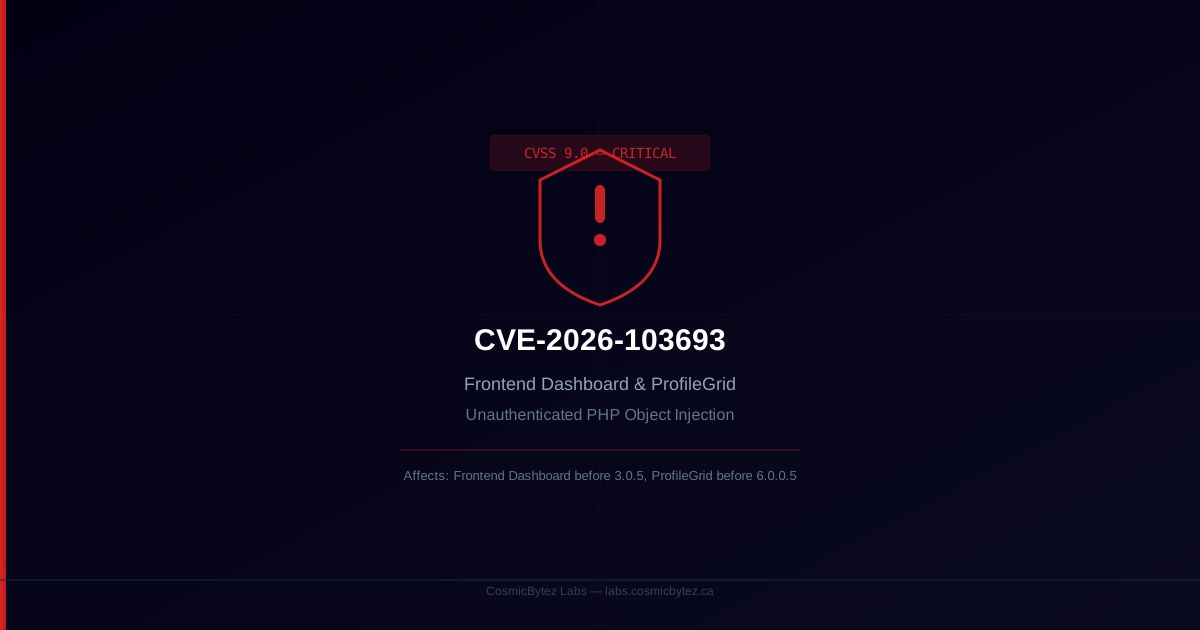
CVE-2026-103693: Unauthenticated PHP Object Injection in Two WordPress Plugins
CVE-2026-103693, published 2026-10-29 by WPScan, affects the Frontend Dashboard and ProfileGrid WordPress plugins. Neither prevents an unauthenticated user from storing a serialized PHP object in user metadata. The object is deserialized when a public profile is viewed, enabling PHP object injection that can lead to arbitrary file write and potentially remote code execution.
NVD lists a CVSS score of 9.0. Some trackers show NVD analysis as pending, and OffSeq rates it High, so treat the exact score as provisional.
Vulnerability Overview
| Attribute | Value |
|---|---|
| CVE ID | CVE-2026-103693 |
| CVSS Score | 9.0 (Critical) per NVD; provisional |
| CWE | CWE-502 (Deserialization of Untrusted Data) |
| Affected Plugins | Frontend Dashboard before 3.0.5; ProfileGrid before 6.0.0.5 |
| Fixed Versions | Frontend Dashboard 3.0.5; ProfileGrid 6.0.0.5 |
| Authentication | None required |
| CNA | WPScan |
Technical Analysis
User metadata fields written by these plugins accept attacker-controlled values without rejecting serialized PHP data. When a public profile page later reads that metadata, WordPress unserializes it automatically. If any class loaded in the request, from WordPress core, a plugin, or a theme, has a usable magic method such as __destruct or __wakeup, the attacker can build a POP chain to write files, and from there reach code execution.
The attack therefore has two stages: plant the payload (unauthenticated), then trigger it by loading the profile page, which an attacker can do themselves.
Exploitation Status
As of 2026-10-29, no public exploit code is indexed in Metasploit or Exploit-DB, and the CVE is not in CISA KEV. Deserialization bugs in popular WordPress plugins are usually weaponized quickly once details circulate.
Remediation
wp plugin update frontend-dashboard profilegrid-user-profiles-groups-and-communities
wp plugin list --fields=name,version,update | grep -i -E "frontend-dashboard|profilegrid"- Update Frontend Dashboard to 3.0.5 or later and ProfileGrid to 6.0.0.5 or later.
- Audit user metadata for serialized objects in user profile fields, for example:
wp db query "SELECT user_id, meta_key FROM wp_usermeta WHERE meta_value LIKE '%O:%:\"%' LIMIT 50;"- Look for unexpected PHP files under
wp-content/uploads/and plugin directories. - Rotate credentials on any site where suspicious metadata or files are found.
- Use a WAF rule that blocks serialized PHP object payloads in form submissions as a stopgap.
Key Takeaways
- CVE-2026-103693 lets unauthenticated visitors plant a payload that executes through PHP deserialization.
- Two plugins share the flaw: Frontend Dashboard (before 3.0.5) and ProfileGrid (before 6.0.0.5).
- Patch now, then check user metadata for serialized objects.
- Membership and profile plugins accept public input by design, so keep them on an auto-update schedule.