Executive Summary
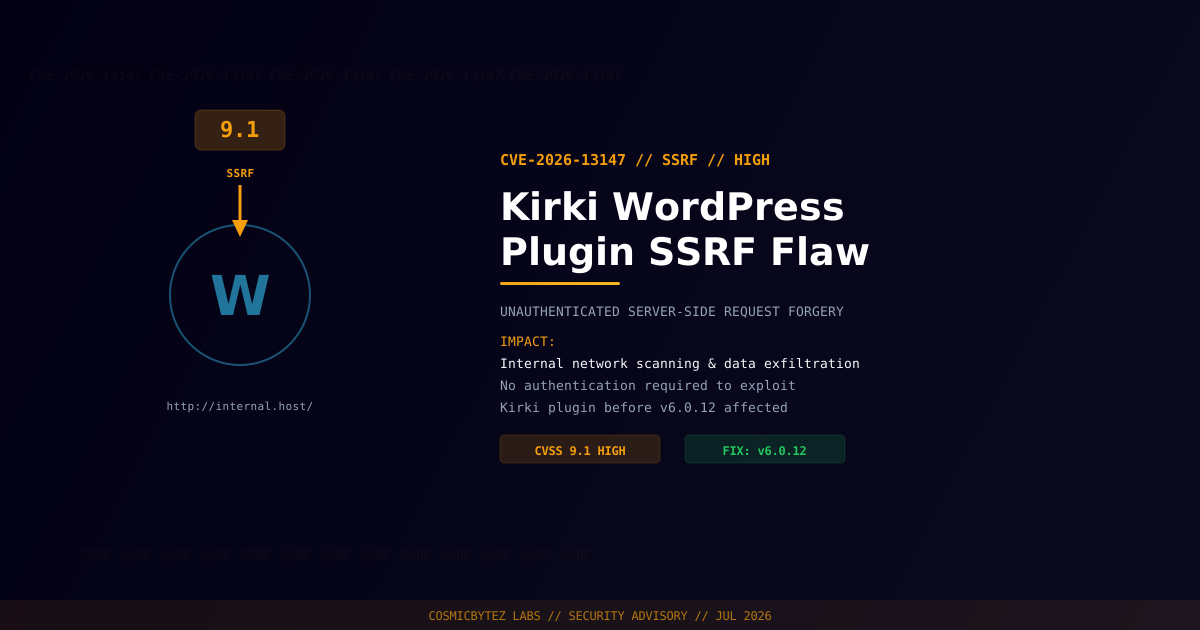
A CVSS 9.1 High server-side request forgery (SSRF) vulnerability (CVE-2026-13147) has been identified in the Kirki Customizer Framework WordPress plugin. Prior to version 6.0.12, the plugin fails to validate user-supplied URLs before making server-side HTTP requests, allowing unauthenticated attackers to force the WordPress server to contact arbitrary internal or external hosts.
This class of vulnerability can be leveraged for internal network reconnaissance, cloud metadata theft, and in some configurations, full server compromise.
Vulnerability Overview
| Attribute | Value |
|---|---|
| CVE ID | CVE-2026-13147 |
| CVSS Score | 9.1 (High) |
| Type | Server-Side Request Forgery (SSRF) |
| Attack Vector | Network |
| Privileges Required | None |
| User Interaction | None |
| Affected Plugin | Kirki Customizer Framework |
What Is Kirki?
Kirki is a widely used WordPress developer toolkit that extends the WordPress Customizer with advanced field types (color pickers, typography controls, sliders, etc.). It simplifies theme development and is used by thousands of WordPress themes and plugins.
Technical Details
The vulnerability exists in a URL-fetching feature within Kirki. The plugin accepts a URL parameter from unauthenticated HTTP requests and passes it directly to a server-side HTTP client (WordPress's wp_remote_get() or similar) without validating that the target is a legitimate external resource.
Attack Scenarios
Scenario 1: Cloud Metadata Exfiltration (AWS/GCP/Azure)
1. Attacker sends request to vulnerable Kirki endpoint with URL:
   http://169.254.169.254/latest/meta-data/iam/security-credentials/
2. WordPress server fetches AWS IMDS metadata
3. Response containing IAM role credentials returned to attacker
4. Attacker uses credentials to pivot into AWS environmentScenario 2: Internal Network Scanning
1. Attacker iterates over internal IP ranges:
   http://10.0.0.1/, http://10.0.0.2/, etc.
2. Response timing and content differences reveal live internal hosts
3. Attacker maps internal services (databases, admin panels, APIs)
4. Further exploitation of discovered servicesScenario 3: Localhost Service Abuse
1. Attacker targets services bound to localhost:
   http://127.0.0.1:6379/ (Redis)
   http://127.0.0.1:11211/ (Memcached)
2. Unauthenticated access to internal services
3. Cache poisoning, data exfiltration, or command injection via protocol abuseAffected Versions
| Plugin | Affected Versions | Fixed Version |
|---|---|---|
| Kirki Customizer Framework | < 6.0.12 | 6.0.12 |
Remediation
Update the Plugin
Update Kirki to version 6.0.12 or later immediately.
# Via WP-CLI
wp plugin update kirki

# Verify installed version
wp plugin get kirki --field=versionOr update through WordPress admin: Plugins > Installed Plugins > Kirki > Update Now.
Block SSRF at Infrastructure Level
Even after patching, implement defense-in-depth controls:
# Block outbound requests to cloud metadata endpoints at the firewall/network level
# AWS: 169.254.169.254
# GCP: 169.254.169.254 / metadata.google.internal
# Azure: 169.254.169.254AWS-specific: Enable IMDSv2 (token-required metadata service), which requires a PUT request before GET and mitigates many SSRF-to-metadata attacks:
# Require IMDSv2 on EC2 instances
aws ec2 modify-instance-metadata-options \
  --instance-id <instance-id> \
  --http-tokens required \
--http-endpoint enabledWordPress-Level Mitigation
// Add to wp-config.php or a must-use plugin to block internal IP access
add_filter('http_request_host_is_external', function($is_external, $host) {
    $blocked = ['169.254.169.254', '127.0.0.1', '::1', 'localhost'];
    if (in_array($host, $blocked)) return false;
    // Also block RFC1918 private ranges
    $ip = gethostbyname($host);
    if (filter_var($ip, FILTER_VALIDATE_IP, FILTER_FLAG_NO_PRIV_RANGE | FILTER_FLAG_NO_RES_RANGE) === false) {
        return false;
    }
    return $is_external;
}, 10, 2);Detection
| Indicator | Description |
|---|---|
Requests to Kirki endpoints with URL parameters pointing to 169.254.169.254 | Cloud metadata SSRF attempt |
| Requests to Kirki endpoints with internal IP addresses | Internal network scanning |
Web server making outbound connections to 127.0.0.1 or RFC1918 addresses | Active SSRF exploitation |
| Unusual IAM credential usage shortly after WordPress plugin activity | Possible successful metadata theft |
Broader Context
SSRF vulnerabilities in WordPress plugins are among the most impactful web vulnerabilities in shared-hosting and cloud-hosted WordPress environments. A single SSRF flaw in a widely installed plugin can lead to:
- Cloud credential theft via metadata services (AWS IMDS, GCP metadata API)
- Internal service exposure in containerized or microservices environments
- Bypass of firewall rules that trust the web server
With Kirki's wide adoption in WordPress themes, this vulnerability has a large blast radius even without widespread exploitation tooling.
References
- NVD — CVE-2026-13147
- Kirki Plugin on WordPress.org
- OWASP SSRF Prevention Cheat Sheet
- AWS IMDSv2 Documentation