Executive Summary
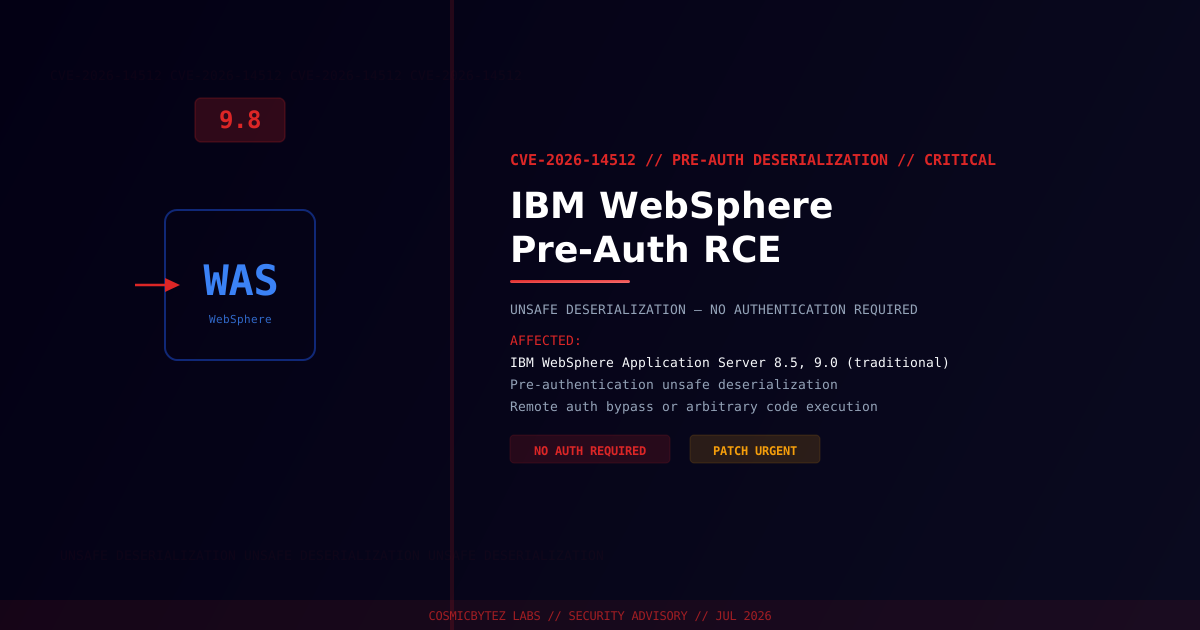
IBM has disclosed CVE-2026-14512, a critical pre-authentication unsafe deserialization vulnerability in IBM WebSphere Application Server (WAS) Traditional versions 8.5 and 9.0. With a CVSS score of 9.8, this flaw allows a remote unauthenticated attacker to either bypass authentication entirely or achieve arbitrary code execution on the server.
CVSS Score: 9.8 (Critical)
This vulnerability is particularly severe because it requires no credentials to exploit. Any network-accessible WebSphere instance running an affected version of the traditional profile is at risk. Immediate patching or mitigation is required.
Vulnerability Overview
| Attribute | Value |
|---|---|
| CVE ID | CVE-2026-14512 |
| CVSS Score | 9.8 (Critical) |
| Type | Pre-Authentication Unsafe Deserialization |
| Outcome | Authentication Bypass or Arbitrary Code Execution |
| Attack Vector | Network |
| Authentication Required | None |
| User Interaction | None |
| Confidentiality Impact | High |
| Integrity Impact | High |
| Availability Impact | High |
Affected Versions
| Product | Profile | Affected Versions | Status |
|---|---|---|---|
| IBM WebSphere Application Server | Traditional | 9.0 | Patch available |
| IBM WebSphere Application Server | Traditional | 8.5 | Patch available |
Note: This vulnerability affects the traditional profile. Liberty profile instances should verify applicability with the IBM Security Bulletin.
Technical Analysis
Unsafe deserialization vulnerabilities occur when an application deserializes attacker-controlled data without sufficient validation. In Java environments like WebSphere, this is particularly dangerous because the Java deserialization mechanism can be weaponized using gadget chains — sequences of existing classes that, when deserialized in the right order, execute arbitrary code.
Why Pre-Authentication Is Critical
Most deserialization flaws require an authenticated session. CVE-2026-14512 is exploitable before any authentication challenge, meaning:
- No credentials are needed
- No prior foothold in the environment is required
- Any attacker who can send a TCP packet to the affected port can attempt exploitation
Common Attack Flow
1. Attacker identifies IBM WebSphere instance (versions 8.5 or 9.0 traditional)
2. Attacker crafts malicious serialized Java object using a known gadget chain
3. Serialized payload sent to the affected WAS endpoint (no auth required)
4. WebSphere deserializes the payload without adequate validation
5. Gadget chain executes — either bypassing auth or running arbitrary code
6. Attacker achieves RCE in the context of the WAS JVM process
7. Full server compromise: data access, lateral movement, persistenceJava Deserialization Gadget Chains
Common libraries known to enable deserialization gadget chains include:
| Library | Known Gadget Chains |
|---|---|
| Apache Commons Collections | Yes |
| Spring Framework | Yes |
| Groovy | Yes |
| JBoss Marshalling | Yes |
Immediate Remediation
Step 1: Apply IBM Security Fix Immediately
# Identify current version
/opt/IBM/WebSphere/AppServer/bin/versionInfo.sh -all | grep -i "version\|fix"

# Download applicable fix from IBM Fix Central
# https://www.ibm.com/support/fixcentral/Consult the IBM Security Bulletin for CVE-2026-14512 for the specific fix pack or interim fix (APAR) for your version.
Step 2: Block Unauthenticated External Access
While patching, restrict all external access to WebSphere service ports:
# Block standard WAS ports from untrusted networks
# SOAP connector (default 8880)
iptables -I INPUT -p tcp --dport 8880 -s <trusted_cidr> -j ACCEPT
iptables -I INPUT -p tcp --dport 8880 -j DROP

# RMI/IIOP connector (default 2809)
iptables -I INPUT -p tcp --dport 2809 -s <trusted_cidr> -j ACCEPT
iptables -I INPUT -p tcp --dport 2809 -j DROP

# HTTP transport (default 9080)
iptables -I INPUT -p tcp --dport 9080 -s <trusted_cidr> -j ACCEPT
iptables -I INPUT -p tcp --dport 9080 -j DROPStep 3: Enable Global Security and Disable Unused Connectors
# In WAS admin console: Security > Global Security
# Ensure administrative security is enabled
# Disable unused connectors (SOAP, JMX, RMI) if not neededStep 4: Deploy a WAF or IDS Rule
Deploy a network-level detection rule targeting serialized Java object traffic:
# Detect Java serialization magic bytes (AC ED 00 05) on WAS ports
alert tcp any any -> $WAS_SERVERS [8880,2809,9080,9443] \
  (msg:"Potential Java Deserialization Attack on WAS"; \
   content:"|AC ED 00 05|"; \
sid:9901234; rev:1;)Detection Indicators
| Indicator | Description |
|---|---|
Inbound TCP with AC ED 00 05 prefix | Java serialization magic bytes — potential exploit attempt |
| Unexpected JVM child processes | Code execution via deserialization |
| New files in WAS temp directories | Payload staging post-exploitation |
| Anomalous outbound connections | C2 beaconing or data exfiltration |
| Authentication bypass events in audit logs | Auth bypass arm of the vulnerability |
Post-Remediation Checklist
- Confirm the IBM fix pack or APAR applied cleanly
- Verify no unauthorized applications deployed during the exposure window
- Review WAS JVM process child processes and network connections
- Rotate all data source passwords and API credentials accessible to WAS
- Audit all administrative accounts for unauthorized additions
- Enable Java 2 security in WAS if not already active
- Review Java deserialization filter configuration (Java serialization filter added in JDK 9+)
References
- IBM Security Bulletin — CVE-2026-14512
- NIST NVD — CVE-2026-14512
- OWASP: Deserialization of Untrusted Data