Executive Summary
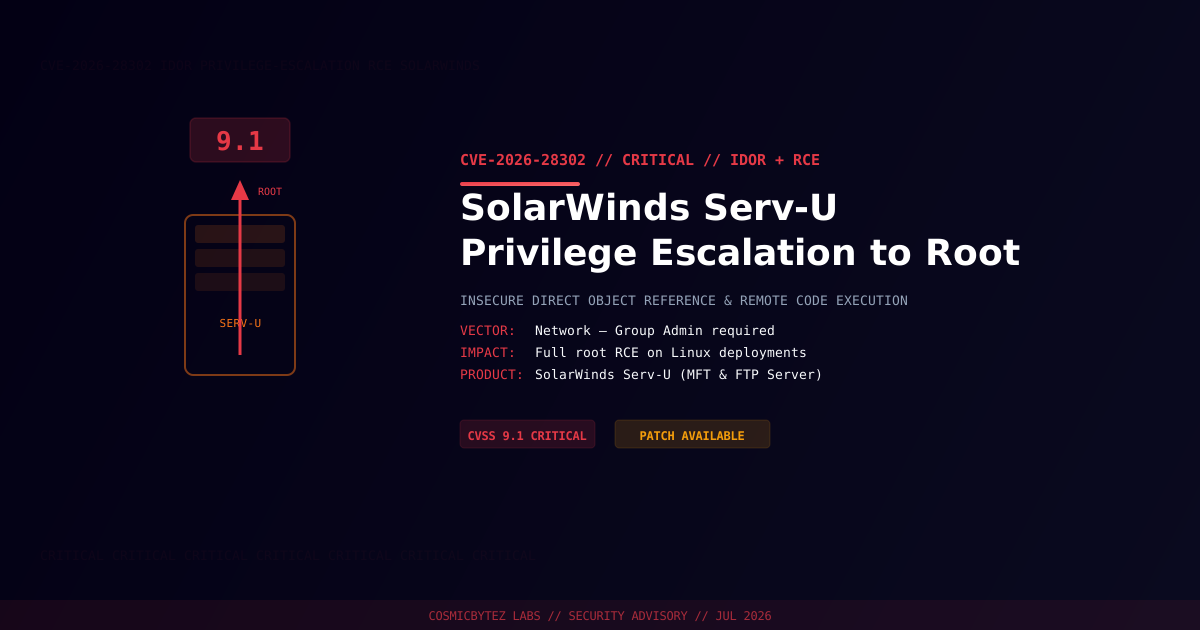
A critical vulnerability tracked as CVE-2026-28302 has been disclosed in SolarWinds Serv-U, the company's widely deployed managed file transfer (MFT) and SFTP server platform. The flaw is classified as an Insecure Direct Object Reference (IDOR) and can be chained to achieve privilege escalation and remote code execution as root on Linux-based deployments.
CVSS Score: 9.1 (Critical)
Exploitation requires group administrator access — not a fully unauthenticated attack path — but the resulting impact is severe: full root-level compromise on Linux systems. Windows deployments face a lower effective impact due to OS-level privilege constraints.
Vulnerability Overview
| Attribute | Value |
|---|---|
| CVE ID | CVE-2026-28302 |
| CVSS Score | 9.1 (Critical) |
| Vulnerability Type | Insecure Direct Object Reference (IDOR) |
| Attack Vector | Network |
| Privileges Required | Group Administrator |
| User Interaction | None |
| Platform Impact | Linux (root RCE) — reduced impact on Windows |
Technical Details
The IDOR vulnerability exists in Serv-U's object reference handling, where a group administrator account can manipulate resource identifiers to access or operate on objects outside their authorized scope. By exploiting this flaw, an attacker with group admin privileges can:
- Reference privileged system objects outside their authorization boundary
- Escalate their effective privileges beyond the group admin role
- Achieve remote code execution as the root user on Linux deployments
The Windows impact is lower because the OS security model limits the blast radius of privilege escalation compared to Linux, where root access provides complete system control.
Attack Chain
1. Attacker obtains or compromises a group administrator account in Serv-U
2. Attacker crafts requests with manipulated object references (IDOR)
3. Serv-U fails to validate that the referenced object belongs to the requester
4. Attacker accesses privileged objects, elevating effective permissions
5. Code execution achieved at root level on Linux deployments
6. Full server compromise — data exfiltration, persistence, lateral movementAffected Versions
Apply the SolarWinds vendor advisory for specific affected version ranges. All Serv-U deployments should be assessed and patched immediately. Linux-hosted deployments carry the highest risk.
Impact Assessment
| Impact Category | Description |
|---|---|
| Remote Code Execution | Execute arbitrary commands as root on Linux |
| Full Server Compromise | Complete control of the Serv-U host system |
| Data Exfiltration | Access all files managed through Serv-U |
| Persistence | Install backdoors surviving service restarts |
| Lateral Movement | Use compromised host as pivot into internal network |
| Credential Theft | Extract SFTP/FTP credentials and private keys |
Remediation
Step 1: Apply the Vendor Patch Immediately
Check the official SolarWinds Security Advisory for the patched version of Serv-U and apply it without delay.
# After patching, verify the installed Serv-U version
# Use SolarWinds' official installer/updater toolingStep 2: Audit Group Administrator Accounts
# Review all accounts with group administrator privileges in Serv-U
# Remove unnecessary group admin grants
# Apply principle of least privilegeStep 3: Restrict Network Access to Serv-U
Limit access to the Serv-U management interface and transfer ports to only trusted networks:
# Firewall — restrict Serv-U management port (default 443/8443) to admin subnets only
# Apply egress filtering on the Serv-U host
Step 4: Monitor for Indicators of Compromise
# Review Serv-U access logs for unusual group admin activity
# Check for unexpected root-level processes on Linux hosts
# Monitor for new scheduled tasks, cron jobs, or persistence mechanisms
# Review outbound network connections from Serv-U hostIf Patching Is Not Immediately Possible
- Restrict group admin access — remove all unnecessary group admin accounts
- Enable IP allowlisting for group admin connections
- Deploy a WAF/IPS with Serv-U signatures to detect IDOR exploitation attempts
- Increase logging on the Serv-U host and route to a SIEM
Detection Indicators
| Indicator | Significance |
|---|---|
| Unexpected root-level process spawned by Serv-U service | Active exploitation |
| Group admin accounts accessing objects outside their scope | Reconnaissance or exploitation |
| Unusual file writes to system directories from Serv-U process | Post-exploitation persistence |
| Outbound connections to external hosts from Serv-U server | Data exfiltration or C2 |
| New cron jobs or service entries on Linux Serv-U host | Persistence mechanism |
SolarWinds Security History Context
SolarWinds has faced several critical vulnerability disclosures in recent years, including the high-profile 2020 supply chain attack (SUNBURST) and subsequent Serv-U flaws exploited by Chinese state-sponsored threat actors (CVE-2021-35211). This latest disclosure underscores that Serv-U remains a high-value target for attackers seeking entry into enterprise file transfer infrastructure.
Organizations should treat all Serv-U vulnerabilities as critical priority given the platform's role in handling sensitive file transfers.
Post-Remediation Checklist
- Confirm Serv-U patched to latest vendor-recommended version
- Audit and reduce group admin account list to minimum necessary
- Verify no unauthorized root-level processes on Linux hosts
- Rotate all credentials for accounts that had group admin access
- Review Serv-U logs for signs of prior exploitation
- Enable enhanced audit logging in Serv-U
- Deploy endpoint detection on the Serv-U host server