Executive Summary
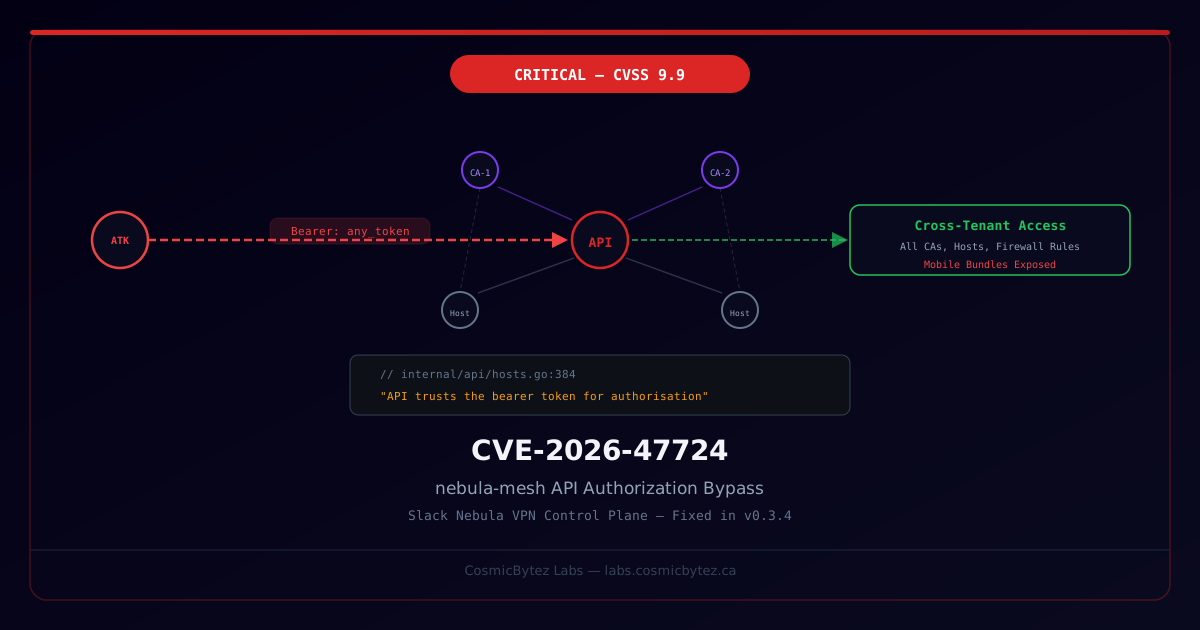
CVE-2026-47724 is a critical authorization bypass vulnerability in nebula-mesh (the self-hosted control plane for Slack's Nebula overlay network) with a CVSS score of 9.9 (Critical). Prior to version 0.3.4, the /api/v1/* route surface validates only that a bearer token is authentic — it does not enforce per-CA ownership or tenant scope at the API layer. Any holder of a valid operator API key can therefore access and manipulate hosts, firewall rules, network configurations, and mobile bundles belonging to other Certificate Authorities (tenants).
The vulnerability was fixed in nebula-mesh v0.3.4. All operators running earlier versions should upgrade immediately.
What Is nebula-mesh
nebula-mesh is an open-source, self-hosted management control plane and web UI for Slack Nebula, a scalable overlay networking tool. nebula-mesh allows operators to manage multiple Nebula nodes, Certificate Authorities (CAs), hosts, firewall rules, and mobile device bundles through a single REST API surface. It is commonly used in multi-tenant deployments where different operators manage separate Nebula CA environments.
Vulnerability Details
Root Cause
The vulnerability is rooted in an asymmetry between the Web UI layer and the API layer:
- Web UI (
internal/web/cas.go): Correctly gates state-changing routes throughloadAccessibleCA— enforcing that the authenticated operator can only access CAs they own. - API layer (
/api/v1/*): Validates only the bearer token's authenticity. Per-CA ownership enforcement is absent. The codebase itself documents this gap atinternal/api/hosts.go:384:
// API trusts the bearer token for authorisation;
// per-CA ownership is enforced only in the Web layer.CA-management endpoints in internal/api/cas.go have proper canAccessCA gates — but the host, network, firewall, and mobile-bundle endpoints in the API layer are unprotected against cross-tenant access.
Attack Scope
Any holder of a non-admin operator API key can:
| Resource | Access Level |
|---|---|
| Hosts (all CAs) | Read, modify, enumerate |
| Network configurations | Read, modify |
| Firewall rules | Read, create, delete |
| Mobile bundles | Read, download |
| Certificate Authorities | Limited (API gates present) |
In a multi-tenant deployment, this amounts to complete cross-tenant privilege escalation: one operator's key grants broad access to all other tenants' Nebula infrastructure.
CVSS Score Breakdown
| Metric | Value |
|---|---|
| Base Score | 9.9 Critical |
| Attack Vector | Network |
| Attack Complexity | Low |
| Privileges Required | Low (any valid operator key) |
| User Interaction | None |
| Scope | Changed (cross-tenant) |
| Confidentiality Impact | High |
| Integrity Impact | High |
| Availability Impact | High |
Affected Versions
| Version | Status |
|---|---|
| < 0.3.4 | Vulnerable |
| 0.3.4 | Patched |
Immediate Remediation
1. Upgrade to nebula-mesh v0.3.4
# Pull the latest release
go install github.com/juev/nebula-mesh@v0.3.4

# Or build from source
git clone https://github.com/juev/nebula-mesh
cd nebula-mesh
git checkout v0.3.4
go build ./...2. Rotate All Operator API Keys
After upgrading, treat all existing operator API keys as potentially compromised — particularly if the API surface was reachable from untrusted networks. Generate fresh keys for all operators through the nebula-mesh admin interface.
3. Network Isolation (Interim)
If immediate upgrade is not possible, restrict access to the /api/v1/* endpoints using network-level controls:
# nginx: restrict API to trusted management IPs
location /api/v1/ {
    allow 10.0.0.0/8;
    allow 192.168.0.0/16;
    deny all;
    proxy_pass http://nebula-mesh:8080;
}Detection
Check your nebula-mesh access logs for cross-CA API requests from unexpected operator keys:
# Review API access logs for /api/v1/ requests
# Flag requests where the operator key doesn't match the CA's expected owner
grep "GET /api/v1/hosts" nebula-mesh.log | \
awk '{print $1, $4}' | sort | uniq -c | sort -rnLook specifically for:
- A single operator key accessing hosts or firewall rules across multiple different CA namespaces
- API requests to host or firewall endpoints during off-hours
- Bulk enumeration patterns (sequential host IDs, large result set fetches)
References
- NIST NVD — CVE-2026-47724
- GitHub Security Advisory — nebula-mesh
- GitLab Advisory Database — CVE-2026-47724
- Slack Nebula — Upstream Project