Executive Summary
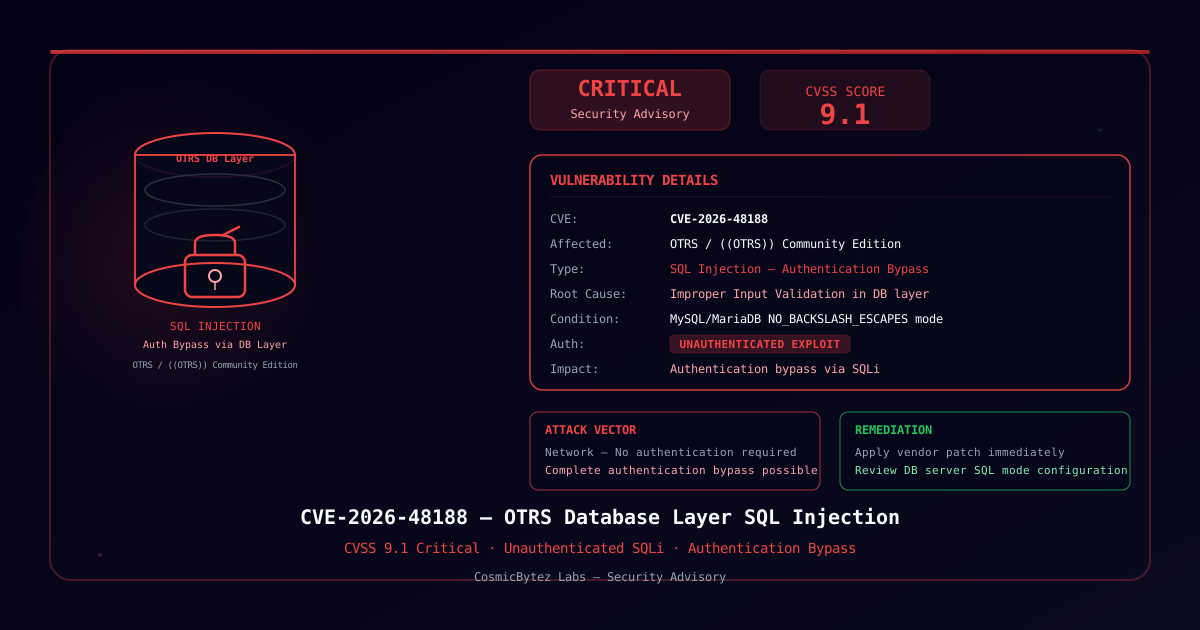
CVE-2026-48188 is a critical SQL injection vulnerability (CVSS 9.1) in the database layer module of OTRS and its open-source fork ((OTRS)) Community Edition. An unauthenticated attacker can exploit improper input validation in the database abstraction layer to inject malicious SQL and bypass authentication entirely — gaining unauthorized access to the system without valid credentials.
The vulnerability is conditional: it only affects deployments where the underlying MySQL or MariaDB server is configured with the NO_BACKSLASH_ESCAPES SQL mode. However, this is a non-trivial configuration, and any affected system is fully exposed to a complete authentication bypass via network.
Vulnerability Details
| Field | Details |
|---|---|
| CVE | CVE-2026-48188 |
| CVSS Score | 9.1 (Critical) |
| Type | SQL Injection — Authentication Bypass |
| Affected Software | OTRS, ((OTRS)) Community Edition |
| Database Condition | MySQL/MariaDB with NO_BACKSLASH_ESCAPES mode |
| Authentication Required | None — unauthenticated exploit |
| Attack Vector | Network |
| Impact | Complete authentication bypass |
Technical Analysis
Root Cause
The vulnerability resides in the database layer module of OTRS, which handles all SQL query construction for the application. Under normal MySQL/MariaDB configurations, backslash characters are used as escape sequences, allowing the application to safely sanitize input that might otherwise break out of SQL string contexts.
However, when MySQL/MariaDB is configured with the NO_BACKSLASH_ESCAPES SQL mode, backslash characters lose their escaping properties entirely — they are treated as regular characters. Any input sanitization logic in OTRS that relies on backslash escaping is therefore rendered ineffective in this configuration.
By crafting authentication requests that exploit this gap, an unauthenticated attacker can inject SQL into the authentication queries, manipulate the logic to return a positive authentication result, and gain access to the OTRS system as if they were a legitimate user.
Attack Vector
Attacker (no credentials)
    ↓
HTTP Login Request — crafted with SQL injection payload
    ↓
OTRS Database Layer — improper input handling when NO_BACKSLASH_ESCAPES enabled
    ↓
MySQL/MariaDB executes manipulated query
    ↓
Authentication check returns success without valid credentials
    ↓
Unauthorized system access granted
The NO_BACKSLASH_ESCAPES Condition
While this configuration is not the default in most MySQL/MariaDB deployments, it is:
- Required or recommended in some strict SQL standards compliance configurations
- Enabled automatically in certain Docker/container deployments or managed database services
- Sometimes set on shared hosting environments or pre-configured appliances
- Required when OTRS is deployed alongside other software that mandates this setting
Organizations should audit their database server configuration to determine if this flag is set:
-- Check current SQL mode
SHOW VARIABLES LIKE 'sql_mode';

-- Look for NO_BACKSLASH_ESCAPES in the outputAffected Products
Any deployment of OTRS or ((OTRS)) Community Edition meeting both of the following conditions is vulnerable:
- Software: OTRS or ((OTRS)) Community Edition — versions prior to the vendor-issued patch
- Database: MySQL or MariaDB server with
NO_BACKSLASH_ESCAPESincluded in the activesql_modesetting
Deployments using PostgreSQL or other database backends are not affected by this specific vulnerability.
Impact Assessment
Successful exploitation provides an unauthenticated attacker with:
- Full access to the OTRS application — including ticket data, customer records, and internal communications
- Potential for privilege escalation within the application once authenticated
- Access to sensitive support/helpdesk data — OTRS is commonly deployed for IT support, HR, and internal ticketing, containing sensitive organizational information
- A foothold for further attacks — authenticated OTRS sessions can be leveraged to reach backend systems, exploit other application vulnerabilities, or pivot within the network
In enterprise environments where OTRS processes sensitive IT tickets, security incidents, or internal requests, unauthorized access can represent a significant data breach.
Remediation
Immediate Fix
Apply the vendor-issued patch for OTRS/((OTRS)) Community Edition immediately.
Monitor the official OTRS security advisories at https://www.otrs.com/otrs-security/ for patch release details and installation instructions.
Secondary Mitigation — Database Configuration
If immediate patching is not possible, consider removing NO_BACKSLASH_ESCAPES from the MySQL/MariaDB sql_mode as a temporary mitigation. This restores the default escaping behavior that the OTRS input sanitization relies on.
-- Remove NO_BACKSLASH_ESCAPES from sql_mode (adjust to match your existing modes)
SET GLOBAL sql_mode = 'STRICT_TRANS_TABLES,NO_ZERO_IN_DATE,NO_ZERO_DATE,ERROR_FOR_DIVISION_BY_ZERO,NO_ENGINE_SUBSTITUTION';Make this change permanent in your MySQL/MariaDB configuration file (my.cnf / my.ini) to survive restarts.
Note: Changing sql_mode may affect other applications sharing the database server — test in a staging environment first.
Network-Level Mitigations
- Restrict OTRS access to trusted internal networks or VPN-connected users
- Apply a Web Application Firewall (WAF) rule to detect and block SQL injection patterns in authentication requests
- Disable public-facing access to the OTRS login page until the patch is applied
Post-Patch Actions
- Audit authentication logs — Review OTRS and database logs for authentication events from unexpected IP addresses or at unusual times
- Check for unauthorized accounts — Verify no backdoor OTRS accounts were created by an attacker
- Review ticket data — Assess whether sensitive data was accessed or exfiltrated
- Rotate credentials — Reset OTRS admin passwords and database passwords as a precaution
- Evaluate data breach obligations — If personal or sensitive data was potentially accessed, evaluate notification requirements under GDPR, CCPA, or other applicable regulations
Detection
To determine if your OTRS deployment is affected:
# 1. Check your database SQL mode configuration
mysql -u root -p -e "SHOW VARIABLES LIKE 'sql_mode';"

# 2. Check if NO_BACKSLASH_ESCAPES appears in the output
# If it does, and you're running an unpatched OTRS version, you are vulnerableFor detecting potential exploitation attempts in OTRS and database logs:
- Look for authentication events from IP addresses not associated with known users
- Check for database query errors in MySQL/MariaDB slow query or error logs around the login endpoint
- Review OTRS access logs (
var/log/OTRS/) for unusual login activity
About OTRS
OTRS (Open Ticket Request System) is a widely deployed enterprise helpdesk and ITSM platform used by organizations worldwide for IT support, service management, and internal ticketing. Its open-source community fork, ((OTRS)) Community Edition, is independently maintained and widely used in cost-sensitive or open-source-preferred environments. Both products process potentially sensitive data including IT incident reports, security tickets, HR requests, and customer communications.