Executive Summary
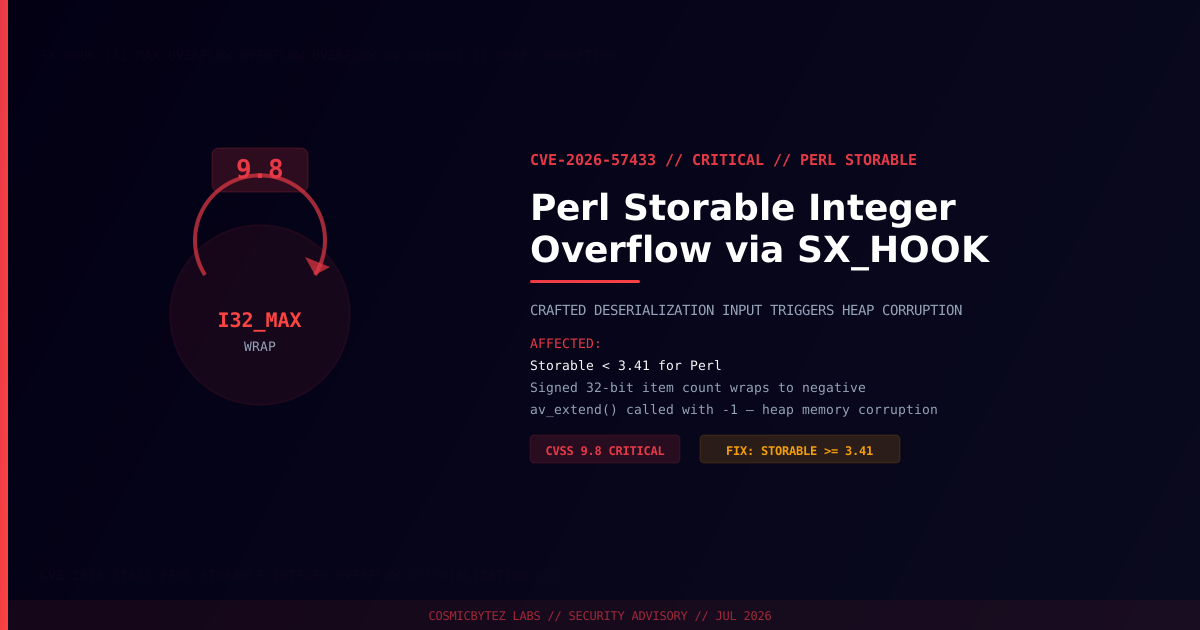
A critical signed integer overflow (CVE-2026-57433, CVSS 9.8) exists in Storable versions before 3.41 for Perl. The vulnerability is triggered during deserialization of a crafted SX_HOOK record: the retrieve_hook_common function reads a signed 32-bit item count, then calls av_extend with count + 1. When count is set to I32_MAX (2,147,483,647), the addition wraps to a negative value, causing av_extend to receive -1 and resulting in heap memory corruption that can be leveraged for arbitrary code execution.
CVSS Score: 9.8 (Critical)
Vulnerability Overview
| Attribute | Value |
|---|---|
| CVE ID | CVE-2026-57433 |
| CVSS Score | 9.8 (Critical) |
| Type | Signed Integer Overflow / Heap Corruption during Deserialization |
| Attack Vector | Network — any application deserializing untrusted Storable data |
| Privileges Required | None |
| User Interaction | None |
| Scope | Unchanged |
| Impact | Confidentiality/Integrity/Availability — Critical |
Affected Versions
| Component | Affected Versions | Fixed Version |
|---|---|---|
| Storable (Perl module) | < 3.41 | 3.41+ |
| Perl (bundled Storable) | Depends on bundled version | Upgrade Storable independently via CPAN |
Technical Analysis
Perl's Storable module is a binary serialization format widely used to persist and transmit Perl data structures. The retrieve_hook_common function handles SX_HOOK records that describe overloaded or blessed objects.
The Overflow
/* Simplified pseudo-code of the vulnerable logic */
I32 count = retrieve_i32(stream);   /* reads signed 32-bit count from attacker */
av_extend(av, count + 1); /* count = I32_MAX → count+1 wraps to -2147483648 */When count equals I32_MAX (0x7FFFFFFF), count + 1 wraps to the most negative I32 value (-2,147,483,648). av_extend interprets this as a request to size the array to a nonsensical negative length, corrupting the heap allocator's internal structures.
Exploitation Path
1. Attacker crafts a serialized Storable blob with SX_HOOK record
2. item count field set to I32_MAX (0x7FFFFFFF)
3. Application calls Storable::retrieve() or thaw() on attacker-controlled data
4. retrieve_hook_common reads I32_MAX → computes I32_MAX + 1 = -2147483648
5. av_extend(-2147483648) corrupts heap
6. Memory corruption leads to arbitrary code execution in the Perl processVulnerable Code Pattern
use Storable qw(thaw retrieve);

# DANGEROUS: deserializing untrusted data
my $data = thaw($user_supplied_bytes);   # CVE-2026-57433 trigger

# Also vulnerable
my $obj = Storable::retrieve($user_path);Impact Assessment
| Impact | Description |
|---|---|
| Remote Code Execution | Heap corruption can be exploited to gain code execution in Perl process |
| Process Crash / DoS | Even without exploitation, heap corruption causes crashes |
| Data Integrity | Corrupted deserialization may produce wrong program state |
| Privilege Escalation | If Perl process runs as a privileged user, escalation is possible |
High-Risk Deployment Scenarios
- Web applications accepting Storable-serialized session data or user payloads
- RPC/IPC systems using Storable to communicate between Perl processes over a network
- Cache layers where serialized objects are stored in Redis/Memcached and served back
- File parsers that accept binary Storable files from end users
Remediation
Step 1: Update Storable to 3.41+
# Via CPAN
cpan Storable

# Via cpanm
cpanm Storable

# Verify installed version
perl -MStorable -e 'print $Storable::VERSION, "\n"'
# Should print 3.41 or higher

# Debian/Ubuntu (may have packaged fix)
apt-get update && apt-get install libstorable-perl

# RHEL/Fedora
dnf update perl-StorableStep 2: Never Deserialize Untrusted Data
Even after patching, deserializing untrusted Storable data is a security anti-pattern:
# AVOID
my $data = thaw($untrusted_input);

# PREFER for external data: use JSON, MessagePack, or Sereal with schema validation
use JSON::XS;
my $data = decode_json($untrusted_input);   # Safer for untrusted sources

# If Storable is required for internal IPC, validate the source
use Storable qw(thaw);
use Digest::HMAC_SHA1 qw(hmac_sha1_hex);

my ($sig, $payload) = split(/\|/, $input, 2);
die "Invalid signature" unless $sig eq hmac_sha1_hex($payload, $SECRET);
my $data = thaw($payload); # Now signed, but still update StorableStep 3: Identify Vulnerable Usage
# Find all Storable deserialization in your codebase
grep -rn 'thaw\|retrieve\|Storable' --include="*.pl" --include="*.pm" .

# Check if untrusted input flows into thaw/retrieve
grep -rn 'thaw(' --include="*.pl" --include="*.pm" . | grep -v '#'Detection
| Indicator | Description |
|---|---|
| Perl process crashes with SIGABRT/SIGSEGV | Heap corruption from malformed Storable input |
| Unexpected process restarts in web apps | May indicate crash-based exploitation attempts |
| Anomalous binary content in session cookies | Storable-serialized session data being tampered with |
av_extend in crash backtraces | Direct indicator of this specific bug |
Post-Remediation Steps
- Upgrade Storable to 3.41 or later on all systems running Perl applications
- Audit all Storable usage — replace untrusted deserialization with safer formats
- Add HMAC signing to any Storable data exchanged over a network or stored externally
- Enable process sandboxing (seccomp, AppArmor) to limit damage from exploitation
- Monitor crash logs for SIGABRT/SIGSEGV patterns in Perl processes