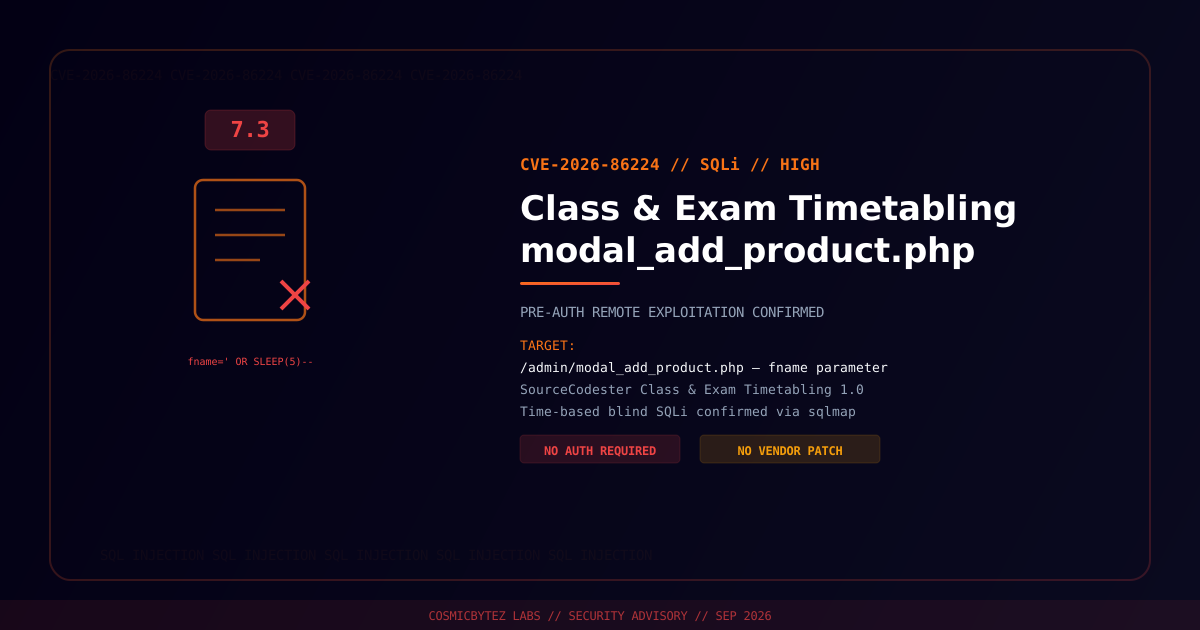
Executive Summary
A third SQL injection vulnerability, CVE-2026-86224, has been disclosed in SourceCodester Class and Exam Timetabling System 1.0, following two related flaws published in the same product line (CVE-2026-86208 and CVE-2026-86209). This time the vulnerable code lives in /admin/modal_add_product.php, where the fname POST parameter is concatenated directly into a mysqli_query() call without sanitization. A proof of concept has confirmed the flaw is exploitable pre-authentication, and public exploit code is already circulating.
CVSS 3.1 Score: 7.3 (High)
Vulnerability Overview
| Attribute | Value |
|---|---|
| CVE ID | CVE-2026-86224 |
| CVSS 3.1 Score | 7.3 (High) |
| CVSS 4.0 Score | 6.9 (Medium) |
| Type | SQL Injection (CWE-89) |
| Attack Vector | Network — remote, unauthenticated |
| Affected Endpoint | /admin/modal_add_product.php |
| Affected Parameter | fname (POST) |
| Exploit Availability | Public exploit published |
| Assigner | VulDB |
Affected Versions
| Product | Affected Versions | Fixed Version |
|---|---|---|
| SourceCodester Class and Exam Timetabling System | 1.0 | None available |
As with the two related flaws in this codebase, no vendor patch currently exists.
Technical Details
admin/modal_add_product.php accepts a POST request carrying fname, lname, arank, designation, department, and go — used to add a staff record from the admin panel. Around line 59 the fname value is read from $_POST and, around lines 65–66, concatenated directly into a mysqli_query() call with no escaping, parameterization, or type validation.
1. Attacker sends a crafted POST request to /admin/modal_add_product.php
2. The request includes a malicious `fname` value and does NOT require
   a valid session cookie — the endpoint fails to enforce authentication
3. The unsanitized parameter reaches mysqli_query() unmodified
4. A quoted payload returns HTTP 200 with visible SQL error output,
   confirming injection
5. A time-based blind technique (fname=' OR SLEEP(5)-- -) was confirmed
   via sqlmap, allowing full database enumeration without ever seeing
query output directlyPre-Authentication Confirmation
Testing against a local Docker deployment showed the endpoint returns a valid response and SQL error output for a quoted fname payload without sending any authenticated session cookie — meaning the admin-panel form is reachable and injectable by an anonymous, unauthenticated attacker despite living under /admin/.
Impact of Successful Exploitation
| Impact | Description |
|---|---|
| Data Exfiltration | Dump staff, student, and exam records via blind SQLi |
| Data Tampering | Insert or corrupt records in the product/staff table |
| Privilege Escalation | Potential access to administrator credentials stored in the same database |
| Server Compromise | Possible OS-level file access if the DBMS account has FILE privileges |
Mitigation
- Restrict access to
/admin/modal_add_product.phpat the web server or firewall level until remediated. - Rewrite the query to use prepared statements with bound parameters instead of string concatenation.
- Enforce session authentication server-side on every
/admin/endpoint — the fact this form ran without a valid session is a separate access-control defect worth auditing. - Validate all POST fields (
fname,lname,arank,designation,department) server-side, rejecting unexpected characters. - Apply WAF rules to catch time-based blind SQLi patterns (
SLEEP(,BENCHMARK(,OR 1=1) targeting this endpoint. - Minimize database account privileges for the web application — no
FILEprivilege, no unnecessary grants.
This is the third SQL injection disclosed in this codebase in roughly a week (see also CVE-2026-86208 and CVE-2026-86209), with related reports for additional modal_add_*.php endpoints also under review by the same researcher. Administrators running this software should treat every endpoint under /admin/modal_add_*.php as unaudited and likely vulnerable until proven otherwise.
Detection Indicators
| Indicator | Description |
|---|---|
POST requests to /admin/modal_add_product.php without a valid session cookie | Authentication-bypass probing |
SLEEP(, BENCHMARK(, or UNION SELECT in the fname field of logged requests | Injection probing |
| Abnormal response-time spikes on this endpoint | Possible time-based blind SQLi in progress |