Executive Summary
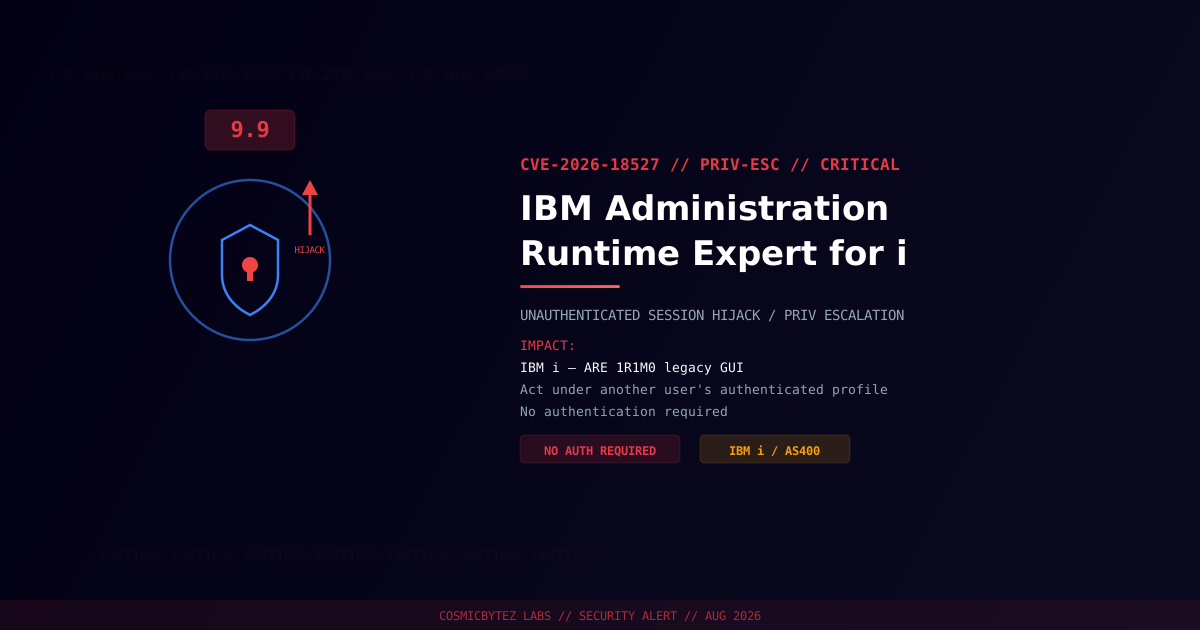
IBM has disclosed a critical privilege escalation vulnerability (CVE-2026-18527) in Administration Runtime Expert (ARE) for i, a GUI-based administration tool for IBM i (AS/400) systems. The flaw carries a CVSS score of 9.9 and is caused by how the ARE GUI component processes sessions, allowing an unauthenticated remote attacker to execute actions under another user's authenticated profile — effectively hijacking that user's privileges without ever presenting valid credentials.
CVSS Score: 9.9 (Critical)
The vulnerability affects ARE 1R1M0. IBM's remediation plan disables the legacy ARE GUI interface outright: a PTF shipping with the Security group on August 31, 2026 removes the affected interface rather than patching it in place, which organizations should factor into upgrade and change-management planning now.
Vulnerability Overview
| Attribute | Value |
|---|---|
| CVE ID | CVE-2026-18527 |
| CVSS Score | 9.9 (Critical) |
| Type | Unauthenticated Session Hijack / Privilege Escalation |
| Attack Vector | Network (no authentication required) |
| Privileges Required | Low (per CVSS vector, though attacker starts unauthenticated) |
| User Interaction | None |
| Vulnerable Component | ARE legacy Web Administration GUI |
| Scope | Changed — attacker acts under a separate user's authenticated context |
Affected Versions
| Product | Affected Versions | Fix |
|---|---|---|
| IBM Administration Runtime Expert (ARE) for i | 1R1M0 | PTF disabling the legacy GUI, shipping with the Security group 2026-08-31 |
Technical Details
ARE for i ships a web-based GUI used by administrators to run diagnostic and administrative tasks against IBM i systems. The vulnerability arises from how that GUI component processes and isolates user sessions: due to a flaw in session handling, an attacker can act under another user's already-authenticated profile without supplying valid credentials of their own.
Because the scope is rated "Changed" in the CVSS vector, exploitation crosses a security boundary — the attacker's actions are attributed to and executed with the privileges of a different, legitimate user, which can include administrators with elevated IBM i authority. On a platform like IBM i, where user profiles frequently carry broad object and command authority, hijacking a privileged session can translate directly into full system compromise.
A related, lower-severity flaw disclosed the same day, CVE-2026-17203 (CVSS 7.5), allows an authenticated remote attacker to obtain sensitive information due to improper authentication enforcement in the same product family — reinforcing that ARE's authentication handling has been under broader scrutiny.
Attack Vector
1. Attacker identifies an IBM i system with ARE's legacy Web Administration GUI exposed
2. Attacker interacts with the vulnerable GUI component without authenticating
3. Session-processing flaw allows the attacker's requests to be treated as an
   already-authenticated user's session
4. Attacker performs actions under that user's authority, including elevated/admin actions
5. Attacker gains footholds consistent with the hijacked user's IBM i authorityImpact of Successful Exploitation
| Impact | Description |
|---|---|
| Privilege Escalation | Unauthenticated attacker inherits another user's authenticated authority |
| Administrative Takeover | If the hijacked session belongs to an admin, full IBM i administrative control |
| Data Exposure | Access to any data or objects reachable under the hijacked profile |
| System Integrity Risk | Ability to run administrative operations against production IBM i workloads |
| Regulatory Exposure | IBM i often hosts core financial/ERP data — compromise carries compliance impact |
Immediate Remediation
Step 1: Apply the August 31, 2026 Security PTF
Track IBM's official security bulletin for ARE and apply the PTF that disables the legacy GUI interface as soon as it is available for your release.
# On the IBM i partition, check currently installed PTF groups
WRKPTFGRP

# Confirm whether the Security group PTF addressing ARE has been applied
DSPPTF LICPGM(5770SS1)Step 2: Restrict Access to the ARE GUI in the Interim
- Firewall or restrict network access to the ARE Web Administration interface to trusted management networks only
- Disable the legacy GUI manually if your environment does not require it, ahead of the PTF
- Avoid exposing ARE administration interfaces to the broader internal network, let alone the internet
Step 3: Review for Signs of Session Abuse
# Review IBM i audit journal (QAUDJRN) for anomalous profile-switching activity
DSPJRN JRN(QSYS/QAUDJRN) ENTTYP(PW AF)

# Check for administrative actions performed by profiles inconsistent with
# expected login patterns or timesIf Immediate Patching Is Not Possible
- Disable the legacy ARE GUI entirely until the PTF is applied
- Restrict network reachability of ARE to a hardened management VLAN
- Increase monitoring on high-privilege IBM i profiles for unexpected activity
- Notify IBM i administrators to be alert for unexplained actions under their accounts
Detection Indicators
| Indicator | Description |
|---|---|
| Administrative actions with no corresponding login event | Possible session hijack via the flaw |
| Access to the ARE GUI from unexpected source IPs | Reconnaissance or exploitation attempt |
| Privileged actions occurring outside normal admin working hours | Potential unauthorized session reuse |
| Discrepancies between QAUDJRN authentication and action entries | Evidence of profile impersonation |
Post-Remediation Steps
- Confirm the Security PTF group (shipping 2026-08-31) is applied and the legacy GUI is disabled
- Audit all administrative profiles for unexpected recent activity predating the patch
- Rotate credentials for high-privilege IBM i profiles as a precaution
- Review firewall rules restricting access to IBM i administration interfaces generally
- Track CVE-2026-17203 and apply its corresponding fix as part of the same maintenance window
- Document the change disabling the legacy GUI for future audit and compliance review
References
- IBM Support — Security Bulletin: IBM i Affected by Privilege Escalation Vulnerability in Web Administration GUI
- NVD — CVE-2026-18527
- GBHackers — IBM i Vulnerability Allows Attackers to Escalate Privileges