Executive Summary
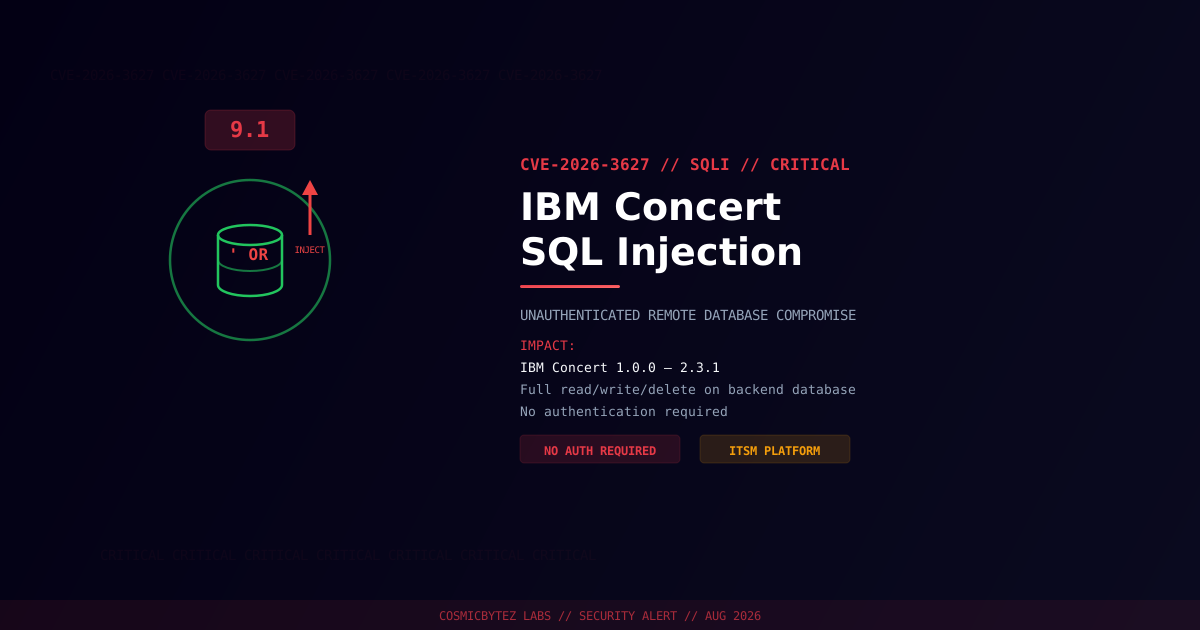
IBM has disclosed a critical SQL injection vulnerability (CVE-2026-3627) affecting IBM Concert, its AIOps and application resource management platform. The flaw carries a CVSS score of 9.1 and allows a remote, unauthenticated attacker to send specially crafted SQL statements to the application, potentially enabling them to view, add, modify, or delete data in the backend database.
CVSS Score: 9.1 (Critical)
IBM Concert versions 1.0.0 through 2.3.1 are affected. No public proof-of-concept is known at this time, but the combination of no authentication requirement, network attack vector, and full CRUD impact on the backing database makes this a high-priority patch for any organization running Concert to monitor application health, dependencies, or operational risk across their environment.
Vulnerability Overview
| Attribute | Value |
|---|---|
| CVE ID | CVE-2026-3627 |
| CVSS Score | 9.1 (Critical) |
| Type | SQL Injection |
| Attack Vector | Network (no authentication required) |
| Privileges Required | None |
| User Interaction | None |
| Impact | Confidentiality: High, Integrity: High, Availability: None |
Affected Versions
| Product | Affected Versions | Recommendation |
|---|---|---|
| IBM Concert | 1.0.0 through 2.3.1 | Apply IBM's fix per the official security bulletin |
Technical Details
IBM Concert aggregates operational, dependency, and risk data across an organization's application landscape, which typically means its backend database holds a broad map of infrastructure, application, and configuration metadata — a high-value target in its own right.
The vulnerability arises from insufficient sanitization of user-supplied input before it is incorporated into SQL statements executed against Concert's backend database. Because no authentication is required and the CVSS vector shows no privileges or user interaction needed (AV:N/AC:L/PR:N/UI:N), any network-reachable Concert instance is exposed to attackers who can reach the vulnerable endpoint, without needing valid credentials first.
IBM's advisory does not name the specific injection point, and no public proof-of-concept has surfaced yet — but the confirmed impact (full read/write/delete on the backend database, C:H/I:H) means successful exploitation compromises the integrity and confidentiality of all data Concert manages, including potentially sensitive operational and dependency metadata about the rest of the environment it monitors.
Attack Vector
1. Attacker identifies a network-reachable IBM Concert instance (1.0.0-2.3.1)
2. Attacker sends a crafted request containing malicious SQL payloads to a
   vulnerable input point (parameter, header, or API field)
3. Concert incorporates the unsanitized input directly into a backend SQL query
4. Database executes the injected SQL, returning, modifying, or deleting data
5. Attacker extracts sensitive operational data or tampers with records used
for downstream risk/dependency decisionsImpact of Successful Exploitation
| Impact | Description |
|---|---|
| Data Exfiltration | Full read access to Concert's backend database contents |
| Data Tampering | Insertion, modification, or deletion of records |
| Operational Risk Data Poisoning | Falsified dependency/risk data could mask real vulnerabilities elsewhere |
| Credential Exposure | Potential exposure of stored credentials or connection secrets in the DB |
| No Authentication Barrier | Any network-reachable instance is exploitable without a foothold |
Immediate Remediation
Step 1: Apply IBM's Fix
Consult IBM's official security bulletin for Concert and apply the patched version as soon as it is confirmed available for your deployment.
# Check the currently deployed Concert version against IBM's advisory
# (version reporting depends on your Concert deployment method — container,
# appliance, or on-prem install)Step 2: Restrict Network Exposure
- Ensure Concert is not directly reachable from the public internet
- Place it behind a WAF capable of detecting and blocking SQL injection patterns
- Restrict access to the management network or VPN-only access
Step 3: Audit for Signs of Exploitation
# Review web/application server logs for SQL-injection-pattern requests
grep -iE "union select|or 1=1|sleep\(|benchmark\(|xp_cmdshell" /path/to/concert/logs/*.log

# Review database audit logs for anomalous queries outside expected
# application query patternsIf Immediate Patching Is Not Possible
- Deploy or tune WAF rules to block common SQL injection payloads in front of Concert
- Restrict network access to Concert to only the systems and users that require it
- Enable database-level query auditing to catch anomalous statements
- Monitor for data integrity issues in Concert's operational/risk reporting
Detection Indicators
| Indicator | Description |
|---|---|
| Requests containing SQL metacharacters or keywords to Concert endpoints | Possible injection attempt |
| Unexpected database errors in Concert application logs | Sign of malformed injected queries |
| Anomalous or unauthorized changes to risk/dependency data in Concert | Possible successful data tampering |
| Database queries with structure inconsistent with the application's normal patterns | Evidence of injected SQL execution |
Post-Remediation Steps
- Confirm the patched Concert version is deployed per IBM's advisory
- Audit the backend database for unauthorized data changes predating the patch
- Rotate any credentials that may have been stored in or accessible via the compromised database
- Review WAF and network access controls protecting Concert going forward
- Cross-check operational/risk data Concert reports against known-good baselines for tampering
- Track IBM's security bulletin page for any follow-up advisories on this CVE
References
- IBM Support — Security Bulletin: Multiple Vulnerabilities in IBM Concert Software
- NVD — CVE-2026-3627