Executive Summary
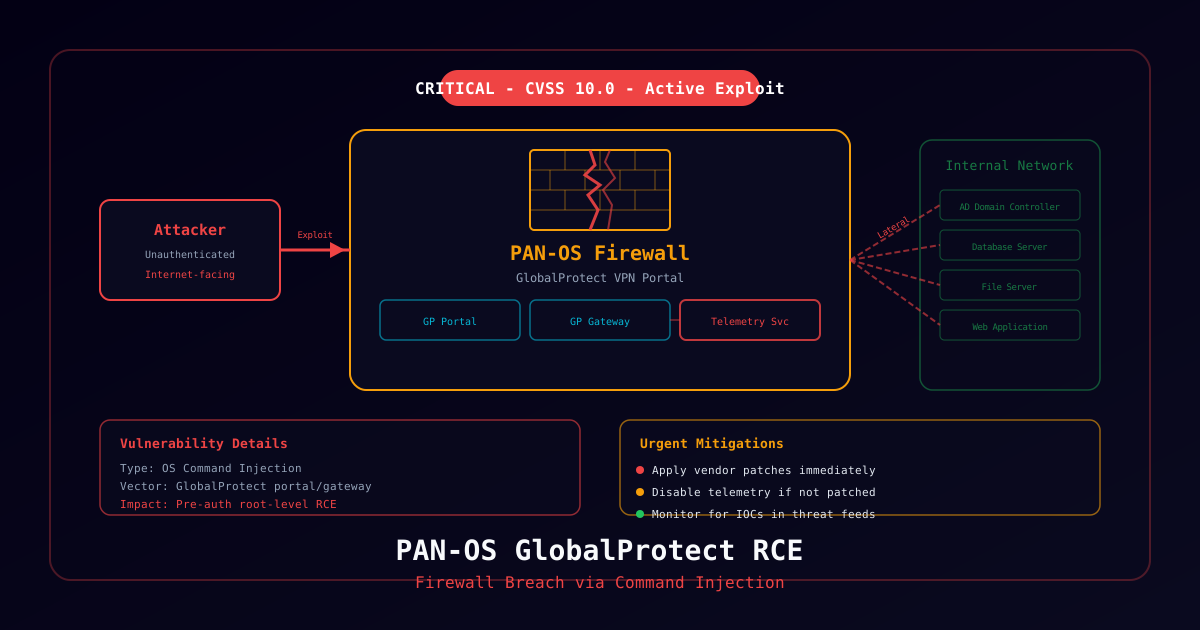
Palo Alto Networks has disclosed a critical remote code execution vulnerability in PAN-OS GlobalProtect gateway that allows unauthenticated attackers to execute arbitrary commands as root on affected firewalls. The vulnerability, tracked as CVE-2026-0778, has been assigned a CVSS score of 9.8 and is reportedly being exploited in limited targeted attacks.
Organizations running GlobalProtect gateway should patch immediately or apply the recommended workarounds.
Vulnerability Overview
Root Cause
The vulnerability exists in the GlobalProtect gateway's HTTP request handling for the portal and gateway login interfaces. A specially crafted HTTP request can exploit a command injection flaw in the session management component, allowing execution of arbitrary operating system commands without authentication.
Attack Chain
1. Attacker identifies internet-facing GlobalProtect gateway
2. Sends crafted HTTP POST to /ssl-vpn/hipreport.esp
3. Malicious payload injected into session validation parameter
4. PAN-OS processes payload without sanitization
5. Arbitrary command execution as root on PAN-OS
6. Attacker establishes persistent backdoor on firewallTechnical Details
Affected Versions
| PAN-OS Version | Affected | Fixed Version |
|---|---|---|
| 11.1.x | < 11.1.4-h3 | 11.1.4-h3 |
| 11.0.x | < 11.0.6-h2 | 11.0.6-h2 |
| 10.2.x | < 10.2.12-h1 | 10.2.12-h1 |
| 10.1.x | Not affected | N/A |
| Cloud NGFW | Not affected | N/A |
| Prisma Access | Not affected | N/A |
CVSS v3.1 Vector
CVSS:3.1/AV:N/AC:L/PR:N/UI:N/S:U/C:H/I:H/A:H
| Metric | Value |
|---|---|
| Attack Vector | Network |
| Attack Complexity | Low |
| Privileges Required | None |
| User Interaction | None |
| Scope | Unchanged |
| Confidentiality | High |
| Integrity | High |
| Availability | High |
Exploitation Requirements
- GlobalProtect gateway or portal must be enabled
- No authentication required
- No user interaction required
- Standard HTTPS connectivity to the management/gateway interface
Indicators of Compromise
Network Indicators
- Anomalous POST requests to
/ssl-vpn/hipreport.espwith oversized parameters - Unexpected outbound connections from PAN-OS management plane
- DNS queries to unusual domains from the firewall
- Large data transfers from the firewall to external IPs
Host Indicators
Check PAN-OS system logs for:
# CLI commands to check for compromise
show system log pan-task
show log system subtype eq management
show running resource-monitor

# Look for unauthorized configuration changes
show config diff running candidate
debug software restart process management-server
Suspicious File Paths
/opt/pancfg/mgmt/saved-configs/*.xml— Check for unauthorized config backups/var/log/pan/*.log— Review for command injection artifacts/tmp/— Look for unexpected scripts or binaries
Immediate Remediation
Option 1: Patch (Recommended)
Upgrade to the fixed PAN-OS version for your branch:
# From PAN-OS CLI
request system software download version 11.1.4-h3
request system software install version 11.1.4-h3
Option 2: Workaround (If Patching Is Delayed)
- Disable GlobalProtect portal/gateway if not actively needed
- Restrict access to GlobalProtect interfaces via Panorama/device ACLs:
# Restrict GlobalProtect to known IP ranges
set network profiles zone-protection-profile gp-protect
set network interface ethernet1/1 zone-protection-profile gp-restrict
- Enable Threat Prevention signature (Threat ID 95187) if available
- Monitor logs for exploitation attempts
Option 3: Emergency Mitigation
Place a web application firewall or reverse proxy in front of GlobalProtect to filter malicious requests to /ssl-vpn/hipreport.esp.
Detection Rules
Snort/Suricata Rule
alert http any any -> any any (
  msg:"CVE-2026-0778 PAN-OS GlobalProtect RCE Attempt";
  flow:to_server,established;
  content:"POST"; http_method;
  content:"/ssl-vpn/hipreport.esp"; http_uri;
  pcre:"/(?:;|\||`|\$\()/";
  sid:2026077801;
  rev:1;
)
Palo Alto Cortex XDR
Cortex XDR customers should ensure they have the latest content update (CU-1045+) which includes behavioral detection for this exploitation technique.
Vendor Response
Palo Alto Networks released the advisory on February 7, 2026 with hotfix availability. The company has:
- Activated Threat Prevention signature updates
- Provided Cortex XDR detection content
- Published detailed remediation guidance
- Coordinated with CISA for KEV catalog inclusion