Overview
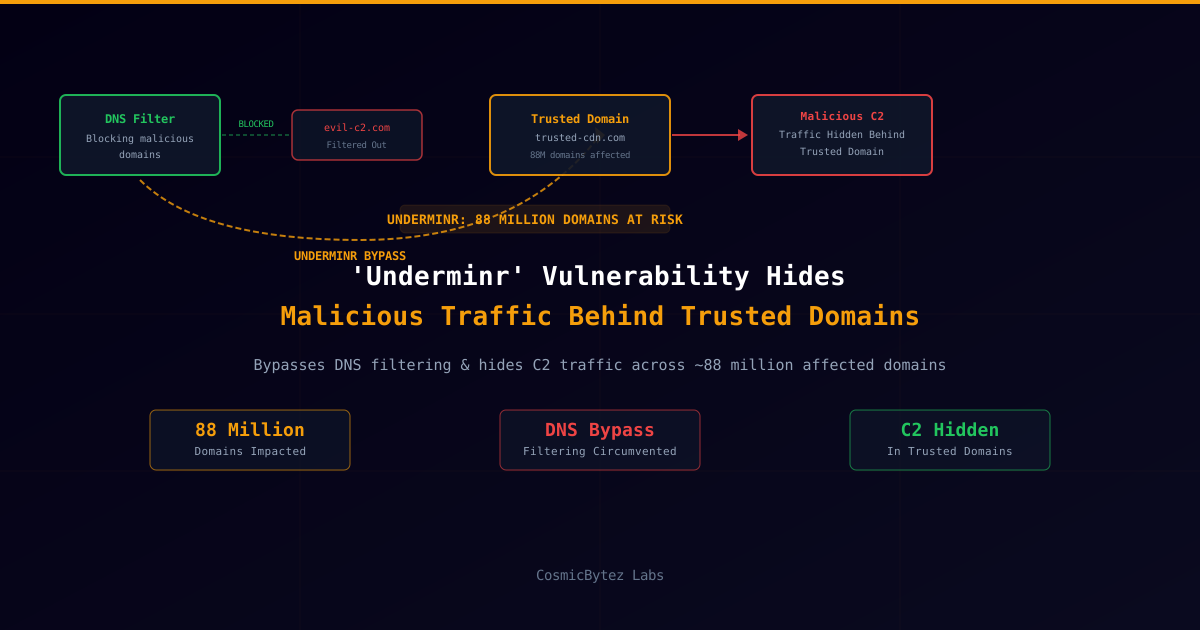
Security researchers have disclosed a stealthy vulnerability dubbed "Underminr" that allows attackers to hide malicious command-and-control (C2) traffic behind trusted, legitimate domain names — effectively bypassing DNS-based security filtering tools that millions of organizations rely on.
The vulnerability impacts an estimated 88 million domains and represents a fundamental weakness in how DNS delegation and domain trust hierarchies are handled, enabling threat actors to route malicious traffic through domains that security tools are configured to trust.
How Underminr Works
Traditional DNS filtering works by maintaining blocklists of known malicious domains. When a user or system attempts to connect to a blocked domain, the DNS resolver intercepts the request and prevents the connection.
Underminr exploits a flaw in how certain DNS configurations handle delegated authority and CNAME chains:
- Attacker registers or compromises a subdomain on a domain that falls within the trusted category of a target organization's DNS filter
- The subdomain is configured to relay traffic — either via CNAME redirection, DNS delegation, or similar mechanism — to attacker infrastructure
- DNS filtering tools see only the trusted parent domain and allow the connection through
- Malicious C2 traffic flows freely hidden behind the legitimacy of the trusted domain's reputation
The result is that DNS-based security products, Secure Web Gateways (SWGs), and network monitoring tools may fail to detect or block C2 communications from malware installed on endpoints within the protected environment.
Scope of Impact
| Metric | Value |
|---|---|
| Affected Domains | ~88 million |
| Vulnerability Type | DNS trust chain abuse / C2 bypass |
| Security Tools Bypassed | DNS filtering, SWG, network monitoring |
| Exploitation Complexity | Low to moderate |
The 88 million domain figure reflects the breadth of domains that could be leveraged as "trusted pivots" — including legitimate CDNs, cloud provider domains, SaaS platforms, and other widely allowlisted services.
Implications for Security Operations
For defenders relying on DNS filtering:
DNS-based blocking tools (including enterprise DNS firewalls, secure DNS resolvers, and endpoint DNS protection) may provide a false sense of security if attackers are aware of this technique. Organizations should not rely solely on DNS filtering as a detection or prevention control for C2 communications.
Scenarios where Underminr is most dangerous:
- Post-compromise C2 persistence — After initial access, malware can beacon out through trusted domains without triggering DNS alerts
- Exfiltration channels — Data exfiltrated via DNS tunneling may be harder to detect when the domain appears legitimate
- Phishing infrastructure — Hosting phishing pages on trusted-domain subdomains to bypass reputation-based email and web filters
Detection Recommendations
Organizations can reduce exposure through layered defenses beyond DNS filtering alone:
Network-level controls:
- Implement full SSL/TLS inspection on outbound traffic — hidden C2 over HTTPS will still be visible as network connections even if DNS appears legitimate
- Deploy behavioral network monitoring that tracks unusual outbound connection patterns regardless of destination domain reputation
- Monitor for abnormal DNS query volumes or unusual CNAME resolution chains
Endpoint controls:
- Endpoint detection and response (EDR) tools that monitor process network activity can detect C2 beaconing based on behavior rather than DNS reputation
- Application allowlisting prevents unauthorized processes from making network connections entirely
DNS hygiene:
- Review and tighten DNS allowlists — not every CDN or cloud platform needs to be universally trusted
- Consider DNS response policy zones (RPZ) that can be tuned beyond simple domain blocklisting
Broader Context
The Underminr disclosure arrives at a time when DNS-based security controls are increasingly strained by the complexity of modern internet infrastructure. The proliferation of CDNs, cloud platforms, and SaaS services has created a vast landscape of "trusted" domains that security tools often treat as safe by default.
Security researchers have previously demonstrated similar bypass techniques against specific security products, but the Underminr research quantifies for the first time the scale of domains susceptible to this class of attack — 88 million represents a substantial fraction of the global domain namespace.
Sources
- SecurityWeek — 'Underminr' Vulnerability Lets Attackers Hide Malicious Connections Behind Trusted Domains