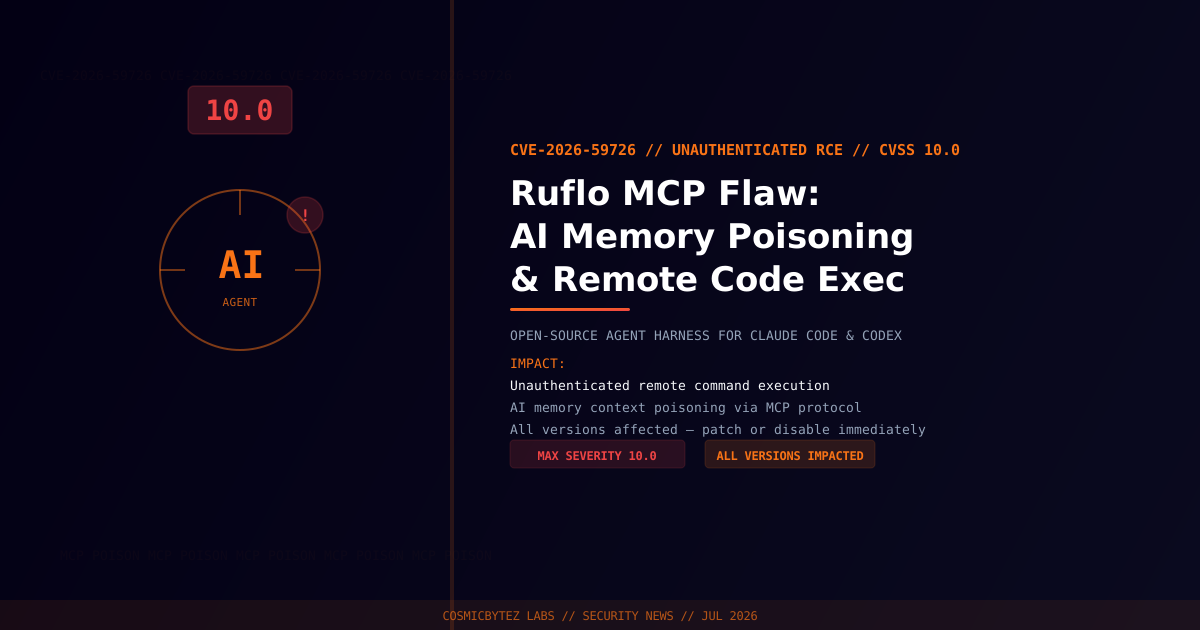
Maximum-Severity Flaw in AI Agent Harness
Cybersecurity researchers have disclosed a CVSS 10.0 vulnerability in Ruflo, an open-source agent meta-harness designed to extend Anthropic Claude Code and OpenAI Codex with additional tooling via the Model Context Protocol (MCP). The flaw, tracked as CVE-2026-59726, allows unauthenticated remote attackers to execute arbitrary commands on the host system and inject poisoned data into the AI agent's memory context.
By the Numbers
| Attribute | Detail |
|---|---|
| CVE | CVE-2026-59726 |
| CVSS Score | 10.0 (Critical — Maximum) |
| Type | Unauthenticated RCE + AI Memory Poisoning |
| Target | Ruflo agent harness (all versions) |
| AI Systems Affected | Anthropic Claude Code, OpenAI Codex |
| Protocol Abused | Model Context Protocol (MCP) |
What Is Ruflo?
Ruflo is an open-source "meta-harness" — a layer that sits between AI coding agents (like Claude Code or Codex) and the tools and resources they access through MCP. It provides extended orchestration, tool chaining, and memory capabilities, making it popular among developers building automated AI-driven workflows.
Because Ruflo mediates MCP tool calls made by the AI agent, it occupies a privileged position: it can execute system commands, read and write files, access network resources, and — critically — influence the context and memory the AI model uses when reasoning about future actions.
How the Vulnerability Works
Two Attack Primitives
CVE-2026-59726 delivers two distinct attack primitives, both exploitable without authentication:
1. Unauthenticated Remote Code Execution
The Ruflo MCP server accepts tool call requests without validating the identity or authorization of the caller. An attacker who can reach the Ruflo MCP listener (by default on a local or network-accessible port) can invoke any registered MCP tool — including system shell execution tools — without credentials.
Attacker → MCP protocol request (no auth) → Ruflo MCP server
         → Ruflo invokes shell tool with attacker-controlled payload
→ Arbitrary command executes on host as the Ruflo process user2. AI Memory Poisoning
Ruflo maintains a memory or context store that the connected AI agent reads to inform its future reasoning and actions. By injecting crafted data into this memory via unauthenticated MCP calls, an attacker can:
- Override the agent's understanding of its current task or environment
- Inject false tool outputs that redirect the AI's subsequent actions
- Establish persistent backdoor instructions that survive across agent sessions
This is a form of indirect prompt injection at the infrastructure level — bypassing all AI-side guardrails by attacking the memory substrate the model depends on.
Impact Assessment
For Individual Developers
Developers running Ruflo locally to augment Claude Code or Codex are at risk if the MCP listener is accessible to other users on the same machine, across a local network, or — in the worst case — via a misconfigured network.
For Enterprise AI Pipelines
Organizations deploying Ruflo as part of automated AI coding or DevSecOps pipelines face the greatest risk:
| Risk | Description |
|---|---|
| Code repository access | Agent has filesystem and git access — attacker inherits it |
| CI/CD compromise | Poisoned AI memory can redirect pipeline decisions |
| Secret exfiltration | Any secrets in the agent's environment are accessible |
| Supply chain attack | Malicious code injected via AI-generated commits |
| Persistent persistence | Memory poisoning survives agent restarts |
Scope of Impact
All versions of Ruflo are affected. The vulnerability is in the MCP server implementation, which lacks any authentication or authorization layer.
Affected:  All Ruflo versions
Fixed:     Patch pending — monitor Ruflo GitHub releases
Workaround: Restrict MCP listener to localhost (127.0.0.1) onlyImmediate Mitigation Steps
Until an official patch is released, organizations and developers using Ruflo should take the following steps:
1. Restrict the MCP Listener to Localhost
Edit the Ruflo configuration to bind the MCP server to 127.0.0.1 only:
# ruflo.config.yaml (or equivalent)
mcp:
  host: "127.0.0.1"  # Never bind to 0.0.0.0 until patched
port: <your_port>2. Add Network-Level Firewall Rules
# Block external access to Ruflo MCP port
iptables -I INPUT -p tcp --dport <ruflo_mcp_port> -s 127.0.0.1 -j ACCEPT
iptables -I INPUT -p tcp --dport <ruflo_mcp_port> -j DROP3. Disable or Remove Ruflo Until Patched
If Ruflo is not critical to current workflows, disable it:
# Stop Ruflo process
pkill -f ruflo

# Remove from AI agent configuration
# Remove Ruflo MCP server entry from .mcp.json or equivalent config4. Audit Memory State and Recent Agent Actions
Review the AI agent's recent activity for signs of memory poisoning:
# Review Ruflo memory store
cat ~/.ruflo/memory/*.json  # Adjust path per your Ruflo config

# Review AI agent action logs
cat ~/.claude/sessions/*.log | grep -i "tool_call\|execute\|write"5. Rotate All Secrets Accessible to the Agent
Any secrets the AI agent could access — API keys, SSH keys, database credentials — should be rotated immediately if Ruflo was exposed:
# Identify secrets in agent environment
env | grep -i "key\|secret\|token\|pass\|credential"Broader Implications for AI Agent Security
CVE-2026-59726 illustrates a critical and underappreciated attack surface: the infrastructure layer beneath AI agents. Most security attention focuses on prompt injection and AI model behavior, but as this vulnerability demonstrates, the tools and memory systems an agent relies on are equally — if not more — dangerous if compromised.
Key Takeaways for AI Security Posture
| Principle | Implementation |
|---|---|
| Authentication on all MCP servers | Never expose MCP endpoints without auth, even locally |
| Least privilege for agent processes | Agent process user should have minimal filesystem rights |
| Memory integrity validation | Hash or sign agent memory stores; verify before use |
| Network isolation for AI pipelines | AI agent environments should be network-isolated by default |
| Audit all agent actions | Log and review every tool call made by AI agents |
Monitor for Updates
The Ruflo project maintainers are expected to release a patch addressing CVE-2026-59726. Organizations should:
- Subscribe to Ruflo GitHub releases for patch announcements
- Monitor the CVE entry at NIST NVD for updated scoring or supplemental advisories
- Apply the patch immediately once released — do not wait for a maintenance window
Sources
- The Hacker News — Ruflo MCP Flaw Lets Unauthenticated Attackers Run Commands and Poison AI Memory
- NIST NVD — CVE-2026-59726