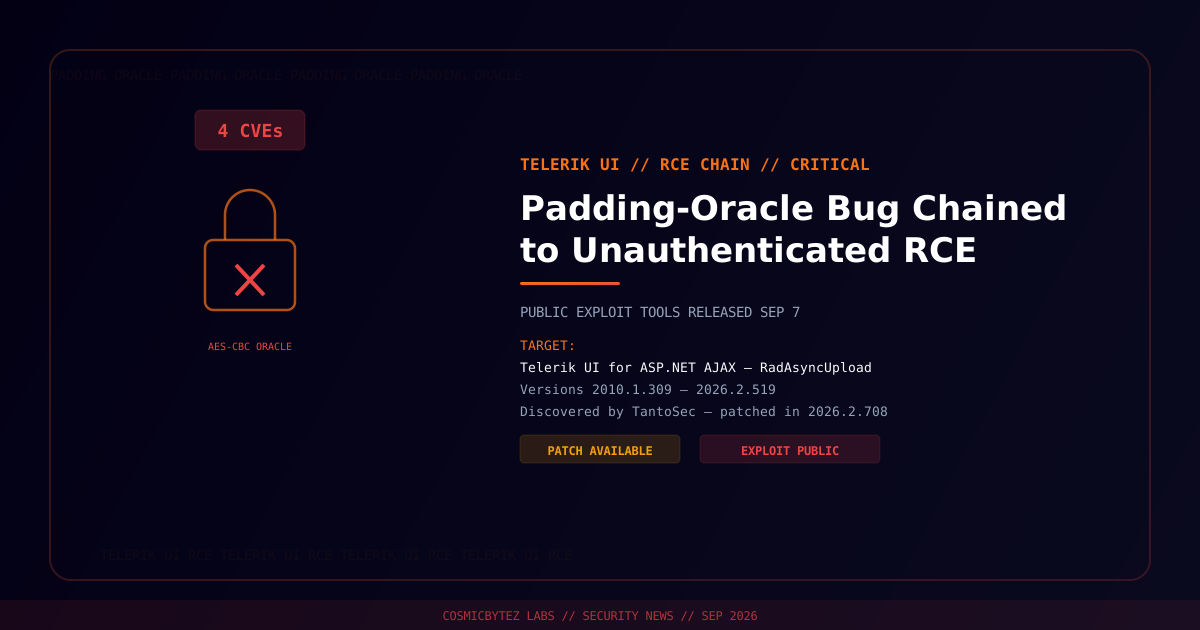
A Cryptographic Oracle Becomes an RCE Chain
Security firm TantoSec has published a public proof-of-concept that chains a classic AES-CBC padding-oracle weakness in Telerik UI for ASP.NET AJAX into full unauthenticated remote code execution. The chain, disclosed responsibly to vendor Progress Software earlier this year, spans four related CVEs and demonstrates how a decades-old cryptographic bug class can still lead to complete server compromise when paired with an unsafe deserializer.
The CVEs
| CVE | Description | CVSS |
|---|---|---|
| CVE-2026-13181 | Unguarded type resolution during deserialization | 8.1 (High) |
| CVE-2026-13182 | Padding oracle in RadAsyncUpload encryption | — |
| CVE-2026-13183 | Timing-based oracle variant of the same flaw | — |
| CVE-2026-13184 | Predictable default encryption key (alternate attack path) | — |
How the Exploit Chain Works
Exploitation requires two conditions that, while not the default configuration, are common enough in real deployments:
- A page renders RadAsyncUpload with a server-side result handler.
- The application uses a non-default, explicit encryption key.
Once those conditions are met, the attack proceeds in stages:
1. Attacker abuses the padding oracle in RadAsyncUpload's encryption
   to decrypt the upload configuration blob — without ever knowing
   the encryption key
2. Attacker forges a malicious configuration specifying an arbitrary
   .NET type
3. Telerik's unguarded deserializer loads and executes a mixed-mode
   DLL from an attacker-controlled location
4. Code executes with IIS application pool privilegesResearchers Marcio Almeida and Justin Steven of TantoSec reported the issues to Progress on May 22, 2026. Progress shipped fixes on July 8 and published the CVEs on July 22 — but TantoSec's exploit tooling only went public on September 7, meaning defenders have had roughly seven weeks to patch before working exploit code became widely available.
Affected Versions
| Product | Affected Versions | Fixed Version |
|---|---|---|
| Telerik UI for ASP.NET AJAX | 2010.1.309 through 2026.2.519 | 2026.2.708 (Q2 SP1) and later |
Mitigation
Progress recommends upgrading immediately to 2026.2.708 or later. For organizations that can't patch right away:
- Set
customErrorstoRemoteOnlyorOn— this blocks the faster, error-message-based variant of the padding oracle. - Disable
RadAsyncUploadentirely if the application doesn't need it. - Remove custom encryption keys where possible, restoring protection under the standard ASP.NET machine key.
- Monitor IIS application pool processes for unexpected child processes or unmanaged DLL loads following upload requests.
Given that public exploit tooling now exists, internet-facing Telerik deployments still running affected versions should be treated as an urgent patching priority.