Overview
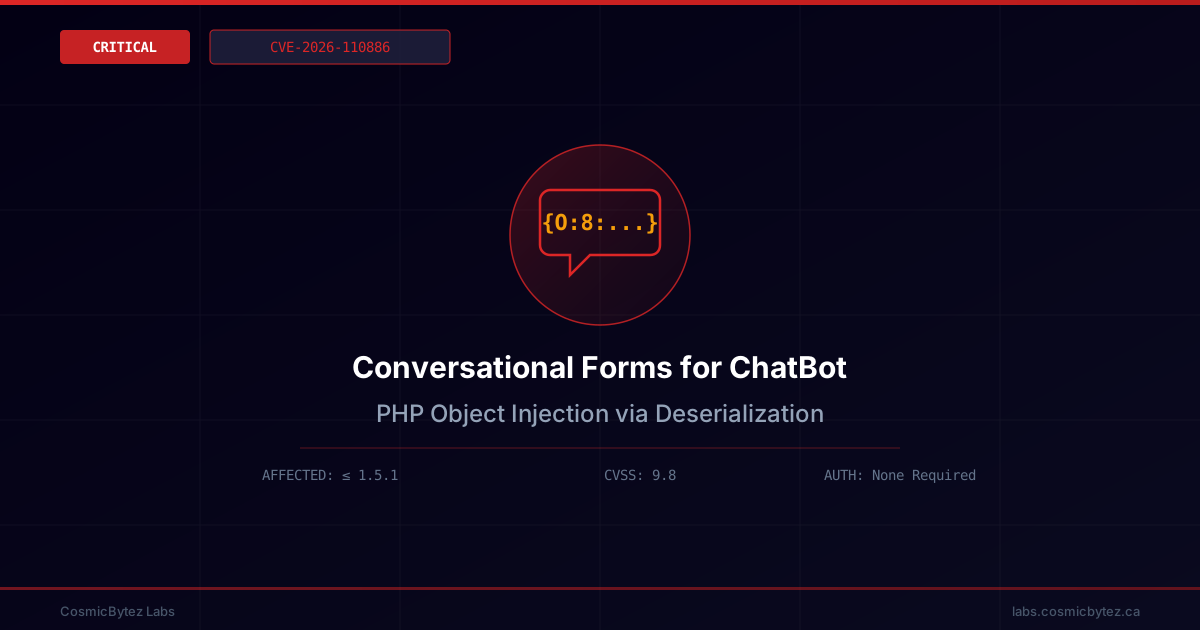
A critical deserialization vulnerability has been disclosed in Conversational Forms for ChatBot, a WordPress plugin from QuantumCloud that builds chat-style lead-capture forms. Tracked as CVE-2026-110886 with a CVSS score of 9.8, the flaw allows an unauthenticated attacker to supply crafted serialized data that the plugin deserializes without adequate validation — a PHP Object Injection condition that can be leveraged toward remote code execution depending on what other "magic method" gadget chains exist in the WordPress install.
Technical Details
| Field | Value |
|---|---|
| CVE ID | CVE-2026-110886 |
| Severity | Critical (CVSS 9.8) |
| CWE | CWE-502 — Deserialization of Untrusted Data |
| Attack Vector | Network |
| Authentication | None Required |
| Privileges Required | None |
| User Interaction | None |
| Impact | Object injection, potential remote code execution |
| Affected Versions | Conversational Forms for ChatBot through 1.5.1 |
| Fixed Version | Not yet published at time of writing — verify current release before assuming patched |
How It Works
The plugin accepts serialized input — most likely tied to how it stores or restores chatbot form session/state data — and passes it to PHP's deserialization routine without sufficiently verifying that the resulting object is safe to instantiate. In a classic CWE-502 pattern, an attacker can hand-craft a serialized string representing an arbitrary PHP object. When the plugin deserializes it, PHP will automatically invoke that object's "magic methods" (such as __wakeup or __destruct) if a class with such a method exists anywhere in the loaded codebase — turning object injection into a practical path toward file writes, SSRF, or remote code execution if a suitable "gadget chain" is present in WordPress core, the active theme, or another installed plugin.
Because the vulnerable path requires no authentication and no user interaction, and the CVSS vector reflects full confidentiality, integrity, and availability impact, this should be treated as a critical RCE-class bug even though no public gadget chain has been documented yet.
Impact Assessment
Who Is At Risk
Any WordPress site running Conversational Forms for ChatBot 1.5.1 or earlier is potentially affected, including sites that:
- Use the plugin's chat widget for lead capture, support intake, or on-site FAQ flows
- Run other plugins or themes that happen to define PHP classes with exploitable magic methods, increasing the real-world severity of the object injection
- Expose the chatbot widget publicly on high-traffic or customer-facing pages
Potential Attack Chains
- Unauthenticated Submission — Attacker crafts a serialized PHP payload and submits it through the vulnerable plugin input path
- Unsafe Deserialization — The plugin deserializes the payload without validating the resulting object type
- Gadget Chain Execution — If a suitable class with exploitable magic methods exists in the site's codebase, PHP automatically triggers it during deserialization
- Code Execution / File Write — Depending on the available gadget chain, the attacker achieves arbitrary file write, SSRF, or full remote code execution on the web server
Mitigation
Immediate Actions
- Check your installed plugin version now. Sites on 1.5.1 or earlier should treat this as urgent given the unauthenticated, zero-interaction attack path.
- Watch for a vendor patch and apply it immediately once released — monitor the plugin's WordPress.org changelog and QuantumCloud's own advisories.
- If no patch is yet available, consider deactivating the plugin on production sites, especially those also running other plugins/themes that could supply a gadget chain.
Detection Opportunities
- Review web server access logs for POST requests to chatbot/form endpoints containing serialized-PHP markers (strings like
O:,a:,s:followed by digit-colon sequences) - Monitor file integrity on the web root for unexpected new or modified PHP files, a common outcome of successful object-injection-to-RCE chains
- Watch for unusual outbound requests from the web server (possible SSRF indicator) following suspicious form submissions
Defence-in-Depth
- Run a WAF capable of detecting serialized-PHP payloads in form submissions as a stopgap ahead of patching
- Minimize the number of plugins/themes active on a site to reduce the pool of potential gadget-chain classes
- Keep PHP and WordPress core current, since some historical gadget chains have been closed by core hardening over time
Discovery & Disclosure
CVE-2026-110886 was reserved October 15, 2026 and published October 18, 2026, with the advisory assigned by Patchstack. As of publication, it is not listed in the CISA Known Exploited Vulnerabilities (KEV) catalog and no public exploit or gadget chain is known to be circulating, but the unauthenticated, full-impact nature of the bug warrants urgent patching once a fix is released rather than waiting for confirmed exploitation.