Executive Summary
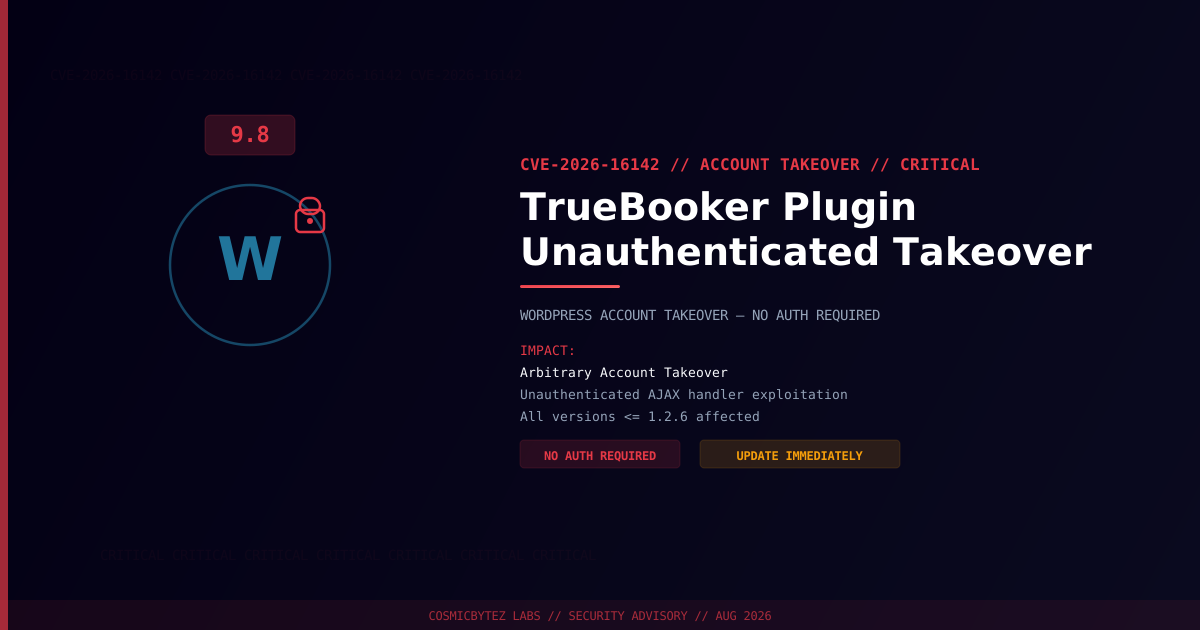
A critical unauthenticated account takeover vulnerability (CVE-2026-16142) has been disclosed in the TrueBooker plugin for WordPress. The flaw carries a CVSS score of 9.8 and allows any unauthenticated attacker to take over arbitrary user accounts — including administrator accounts — without needing any credentials.
CVSS Score: 9.8 (Critical)
The vulnerability exists in the plugin's add_front_user_update() AJAX handler, which is registered for unauthenticated users and accepts an attacker-controlled truebooker_wp_user_id parameter. By passing any WordPress user ID in this parameter, an attacker can modify account details for that user, effectively seizing control of the account.
Vulnerability Overview
| Attribute | Value |
|---|---|
| CVE ID | CVE-2026-16142 |
| CVSS Score | 9.8 (Critical) |
| Type | Unauthenticated Account Takeover |
| Attack Vector | Network (no authentication required) |
| Privileges Required | None |
| User Interaction | None |
| Affected Plugin | TrueBooker ≤ 1.2.6 |
Affected Versions
| Plugin | Affected Versions | Status |
|---|---|---|
| TrueBooker | All versions ≤ 1.2.6 | Patch required |
Technical Details
The root cause is the add_front_user_update() function being registered as an AJAX action available to unauthenticated (non-logged-in) users. The handler accepts a truebooker_wp_user_id parameter directly from user input and uses it without any authorization check to identify which WordPress user account to update.
An attacker can supply any valid WordPress user ID — including the site administrator's — and submit arbitrary update data, effectively overwriting account credentials or email addresses to gain full access.
Attack Sequence
1. Attacker enumerates WordPress user IDs (commonly author=1 leaks admin ID)
2. Attacker crafts POST request to wp-admin/admin-ajax.php
3. Action: add_front_user_update with truebooker_wp_user_id=<target_id>
4. Attacker supplies new email address or password for target account
5. Plugin updates target user account without verifying requester identity
6. Attacker logs in to compromised account — including admin if targetedImpact of Successful Exploitation
| Impact | Description |
|---|---|
| Account Takeover | Full control of any WordPress user account |
| Admin Compromise | Site administrator account can be targeted |
| Data Access | Full access to all site content, user data, and configuration |
| Persistent Access | Attacker retains access until credentials are reset |
| Site Defacement | Admin takeover enables arbitrary content changes |
| Malware Installation | Admin access enables plugin/theme injection |
Immediate Remediation
Step 1: Update or Deactivate TrueBooker
Check for an updated version of TrueBooker that resolves this vulnerability. If no patch is available from the plugin vendor, deactivate and remove the plugin immediately.
# Via WP-CLI — check installed version
wp plugin get truebooker --field=version

# Update if a patched version is available
wp plugin update truebooker

# If no patch is available, deactivate immediately
wp plugin deactivate truebooker
wp plugin delete truebookerStep 2: Audit for Account Compromise
# Check for recently modified admin accounts
wp user list --role=administrator --fields=ID,user_login,user_email,user_registered

# Review user meta for unexpected changes
wp db query "SELECT user_id, meta_key, meta_value FROM wp_usermeta WHERE meta_key='last_update' ORDER BY meta_value DESC LIMIT 20;"

# Check WordPress auth log if available
wp db query "SELECT * FROM wp_options WHERE option_name LIKE '%session%';"Step 3: Reset All Administrative Credentials
# Reset all administrator passwords
wp user list --role=administrator --field=ID | xargs -I{} wp user update {} --user_pass=$(openssl rand -base64 16)

# Regenerate WordPress secret keys
wp config shuffle-salts

# Invalidate all active sessions
wp eval 'delete_option("auth_key"); wp_cache_flush();'Step 4: Block the Vulnerable AJAX Action at WAF
If patching is not immediately possible, block requests to the vulnerable AJAX action:
# Nginx — block the vulnerable action
location /wp-admin/admin-ajax.php {
    if ($arg_action = "add_front_user_update") {
        return 403;
    }
}Detection Indicators
| Indicator | Description |
|---|---|
POST to admin-ajax.php with action=add_front_user_update | Exploitation attempt |
| Unexpected admin account email changes | Successful account takeover |
| New administrator accounts | Post-compromise privilege escalation |
| Login from unusual IPs on admin accounts | Account in use by attacker |
Post-Remediation Steps
- Remove or update TrueBooker to a patched version
- Audit all administrator accounts for unauthorized changes
- Reset all admin passwords and regenerate WordPress secret keys
- Invalidate all active sessions to force reauthentication
- Review recent content changes for unauthorized modifications
- Deploy a WAF (Wordfence, Sucuri) to monitor future AJAX abuse
- Enable two-factor authentication on all administrator accounts