Executive Summary
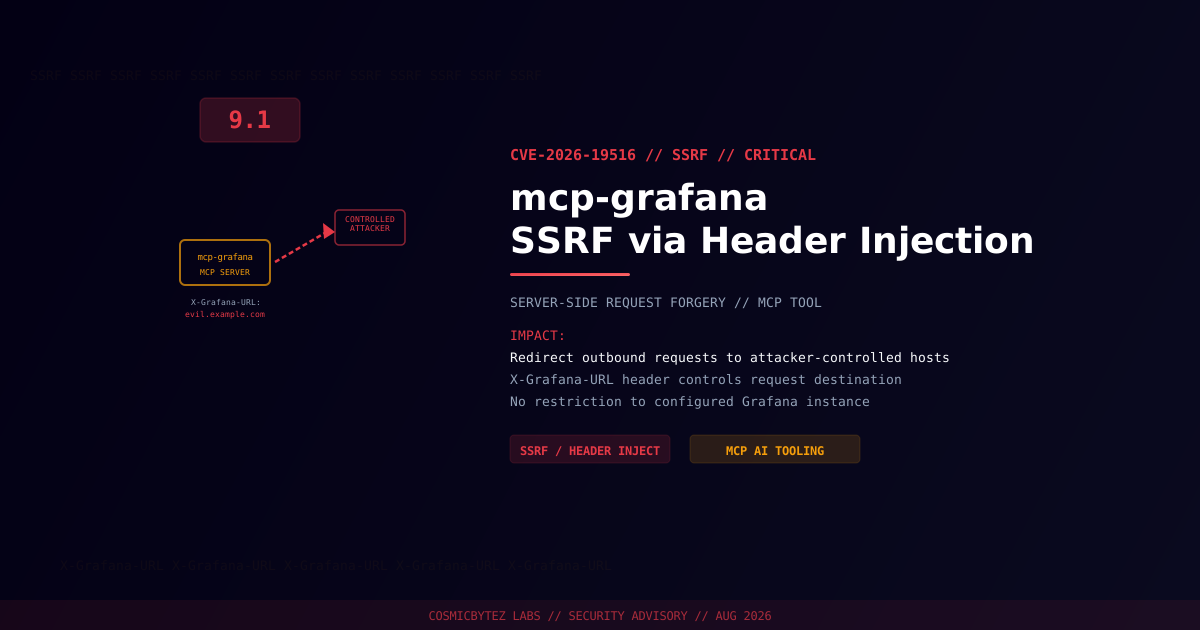
A critical server-side request forgery (SSRF) vulnerability, tracked as CVE-2026-19516, has been disclosed in mcp-grafana — the official Model Context Protocol (MCP) server for Grafana. With a CVSS score of 9.1, the flaw allows a caller to supply a X-Grafana-URL request header that controls the destination of the MCP server's outbound HTTP requests. Combined with the grafana_api_request tool's ability to specify HTTP method, path, and body, an attacker can direct arbitrary requests to any host reachable from the mcp-grafana server — not just the intended Grafana instance.
CVSS Score: 9.1 (Critical)
This vulnerability is particularly significant given the growing deployment of MCP servers in AI agent workflows, where mcp-grafana may have access to internal network resources, cloud metadata endpoints, or sensitive internal APIs.
Vulnerability Overview
| Attribute | Value |
|---|---|
| CVE ID | CVE-2026-19516 |
| CVSS Score | 9.1 (Critical) |
| Type | Server-Side Request Forgery (SSRF) |
| Attack Vector | Network |
| Privileges Required | Low (MCP caller access) |
| User Interaction | None |
| Affected Software | mcp-grafana (official Grafana MCP server) |
Technical Details
Root Cause
The mcp-grafana server reads the X-Grafana-URL header from incoming requests and uses its value as the destination for outgoing HTTP calls. The server does not validate or restrict this value to the configured Grafana instance. Additionally, the grafana_api_request MCP tool exposes control over the HTTP method, path, and request body to callers.
Attack Scenario
1. Attacker has access to an AI agent or MCP client connected to mcp-grafana
2. Attacker crafts a tool call to grafana_api_request with:
   - X-Grafana-URL: http://169.254.169.254/latest/meta-data/ (cloud metadata)
   - Method: GET
   - Path: /iam/security-credentials/
3. mcp-grafana forwards the request to the attacker-controlled destination
4. Response (cloud credentials, internal API data) returned to attacker via MCPVulnerable Code Pattern
# Simplified representation of the vulnerable pattern
def make_grafana_request(request_headers, method, path, body):
    destination = request_headers.get("X-Grafana-URL")  # No validation!
    # destination can be ANY URL, not just the configured Grafana instance
    response = http_client.request(method, f"{destination}{path}", json=body)
return responseSSRF Attack Targets
| Target | Description |
|---|---|
| Cloud Metadata (AWS/GCP/Azure) | Steal IAM credentials via 169.254.169.254 |
| Internal APIs | Access internal services not exposed externally |
| Other Grafana Instances | Pivot to other Grafana deployments on the network |
| Corporate Intranet | Probe and access internal HTTP services |
| Localhost Services | Access services bound to 127.0.0.1 on the MCP host |
Impact
In AI agent deployments where mcp-grafana runs with access to internal networks, cloud provider metadata services, or other sensitive endpoints, successful exploitation could result in:
- Cloud credential theft via IMDS (Instance Metadata Service) requests
- Internal network reconnaissance and lateral movement
- Data exfiltration from internal APIs and services
- Privilege escalation through stolen IAM roles or service accounts
Remediation
Step 1: Update mcp-grafana
Apply the latest patch from the official Grafana repository immediately. The fix validates that the destination URL matches the configured Grafana instance URL.
# If using Go installation
go install github.com/grafana/mcp-grafana@latest

# If using Docker
docker pull grafana/mcp-grafana:latest
docker compose up -d mcp-grafanaStep 2: Restrict Network Access
Until patched, restrict the network access of the mcp-grafana process to only the legitimate Grafana instance:
# Example: restrict outbound with iptables (only allow grafana host)
iptables -A OUTPUT -p tcp -d <grafana-host-ip> --dport 3000 -j ACCEPT
iptables -A OUTPUT -p tcp -j DROP -m owner --uid-owner mcp-grafanaStep 3: Network Segmentation
- Place mcp-grafana in a network segment without access to cloud metadata endpoints
- Block outbound requests to
169.254.169.254(AWS/Azure/GCP IMDS) - Restrict access to internal services from the mcp-grafana host
Step 4: Audit MCP Access Controls
Review which AI agents and MCP clients have access to mcp-grafana and revoke access from untrusted callers:
- Audit MCP client authentication configuration
- Implement allowlists for trusted callers
- Log and monitor all
grafana_api_requesttool calls
Detection
| Indicator | Description |
|---|---|
| Requests to cloud metadata IPs (169.254.x.x) from mcp-grafana | Active SSRF exploitation |
X-Grafana-URL headers pointing to non-Grafana hosts | Exploitation attempt |
| Unexpected outbound connections from mcp-grafana host | Post-exploitation activity |
| Anomalous tool call patterns from AI agents | Potential prompt injection driving SSRF |
AI Security Context
This vulnerability highlights an emerging attack surface in AI agent toolchains. MCP servers act as privileged bridges between AI models and backend systems. When an MCP server has access to internal networks, a SSRF flaw can be weaponized through:
- Direct attacker access to the MCP client
- Prompt injection attacks — a malicious document or web page causes an AI agent to make tool calls that exploit the SSRF
Organizations deploying AI agents with MCP tooling should treat MCP servers as high-privilege components and apply the same security standards as internal APIs.
Post-Remediation Checklist
- Confirm mcp-grafana updated to patched version
- Validate URL destination restriction is enforced (test with non-Grafana URL)
- Review outbound network logs for SSRF exploitation attempts
- Rotate any credentials accessible via the mcp-grafana host's network
- Implement egress filtering for the mcp-grafana network segment
- Audit AI agent system prompts and tool call logs for anomalies