Executive Summary
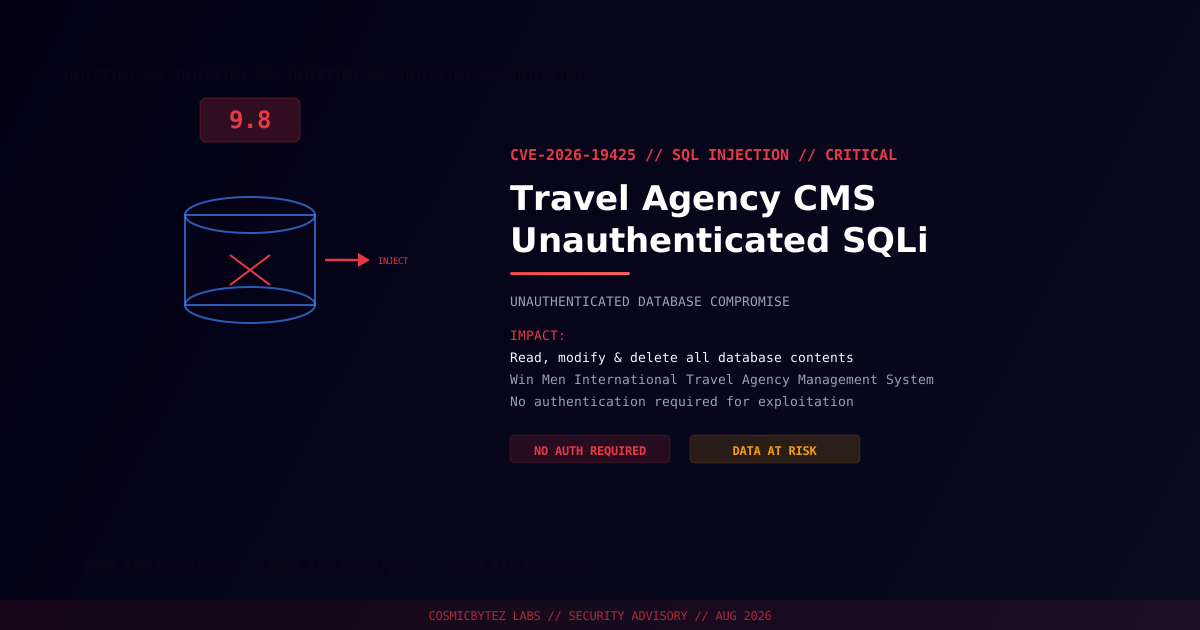
A critical SQL injection vulnerability identified as CVE-2026-19425 has been disclosed in the Travel Agency Management System developed by Win Men International. The flaw carries the maximum-tier CVSS score of 9.8 and enables unauthenticated remote attackers to inject arbitrary SQL commands, granting full read, write, and delete access to all database contents — including customer data, booking records, and administrator credentials.
CVSS Score: 9.8 (Critical)
Vulnerability Overview
| Attribute | Value |
|---|---|
| CVE ID | CVE-2026-19425 |
| CVSS Score | 9.8 (Critical) |
| Type | SQL Injection (Unauthenticated) |
| Attack Vector | Network |
| Privileges Required | None |
| User Interaction | None |
| Affected Software | Travel Agency Management System — Win Men International |
Technical Details
The Travel Agency Management System fails to sanitize user-supplied input before incorporating it into SQL queries. One or more public-facing endpoints (such as booking search or login forms) accept unsanitized parameters that are passed directly to the database engine. Because no authentication is required to reach these endpoints, a remote attacker can inject arbitrary SQL without credentials.
Attack Chain
1. Attacker identifies a public-facing endpoint accepting user input
2. Injects SQL payload into vulnerable parameter (e.g. search field, ID parameter)
3. Database executes injected query with application-level privileges
4. Attacker enumerates database schema, extracts all table contents
5. Attacker modifies or deletes records, or escalates via stored credentialsSample Injection Scenarios
-- Boolean-based blind injection to confirm vulnerability
' AND 1=1--
' AND 1=2--

-- Union-based extraction of user credentials
' UNION SELECT username, password, NULL FROM admin_users--

-- Destructive payload (data deletion)
'; DELETE FROM bookings WHERE 1=1;--Impact Matrix
| Impact | Description |
|---|---|
| Full Data Exfiltration | Extract all customer PII, booking records, payment info |
| Credential Theft | Read admin usernames and password hashes |
| Data Manipulation | Modify or delete booking records |
| Authentication Bypass | Use extracted credentials to log in as admin |
| Reputation & Legal | Data breach liability under GDPR, PIPEDA, and similar regulations |
Affected Versions
All known versions of the Travel Agency Management System by Win Men International are believed affected. No official patch version has been confirmed at time of publication — contact the vendor directly for remediation guidance.
Immediate Remediation
Step 1: Take the Application Offline (if unpatched)
If a vendor patch is not immediately available, take the affected system offline or restrict access to trusted networks to prevent exploitation:
# Example: block public access at the firewall level
# Allow only internal IPs
iptables -I INPUT -p tcp --dport 80 -j DROP
iptables -I INPUT -p tcp --dport 80 -s 192.168.0.0/24 -j ACCEPTStep 2: Apply a WAF Rule
Deploy a Web Application Firewall rule to block common SQL injection patterns while waiting for a patch:
# Nginx example — block common SQLi patterns
if ($args ~* "(union|select|insert|update|delete|drop|alter|exec|benchmark|sleep|load_file|outfile)") {
    return 403;
}Step 3: Apply Vendor Patch
Monitor the vendor (Win Men International) for an official patch and apply it immediately upon release. Validate the fix by confirming parameterized queries or prepared statements are used for all database interactions.
Step 4: Audit for Prior Compromise
# Review web server access logs for SQL injection patterns
grep -iE "(union|select|benchmark|sleep|load_file)" /var/log/nginx/access.log

# Look for unexpected database exports or large data transfers
# Check database binary logs if available
mysqlbinlog /var/lib/mysql/mysql-bin.* | grep -i "SELECT \*"Detection Indicators
| Indicator | Description |
|---|---|
| URL parameters containing SQL keywords | Active injection attempts |
| Unusually long query strings or encoded payloads | Obfuscated injection |
| High volume of requests to booking/search endpoints | Automated scanning |
| Unexpected database queries in slow query log | Successful injection activity |
| New admin accounts in database | Post-exploitation persistence |
Post-Remediation Checklist
- Confirm all user inputs are handled via parameterized queries or an ORM
- Rotate all database credentials and admin passwords
- Review all customer records for unauthorized modifications
- Notify affected customers per applicable breach notification laws
- Enable database query auditing going forward
- Deploy a WAF for ongoing SQL injection protection
- Conduct a full penetration test before returning to production