Executive Summary
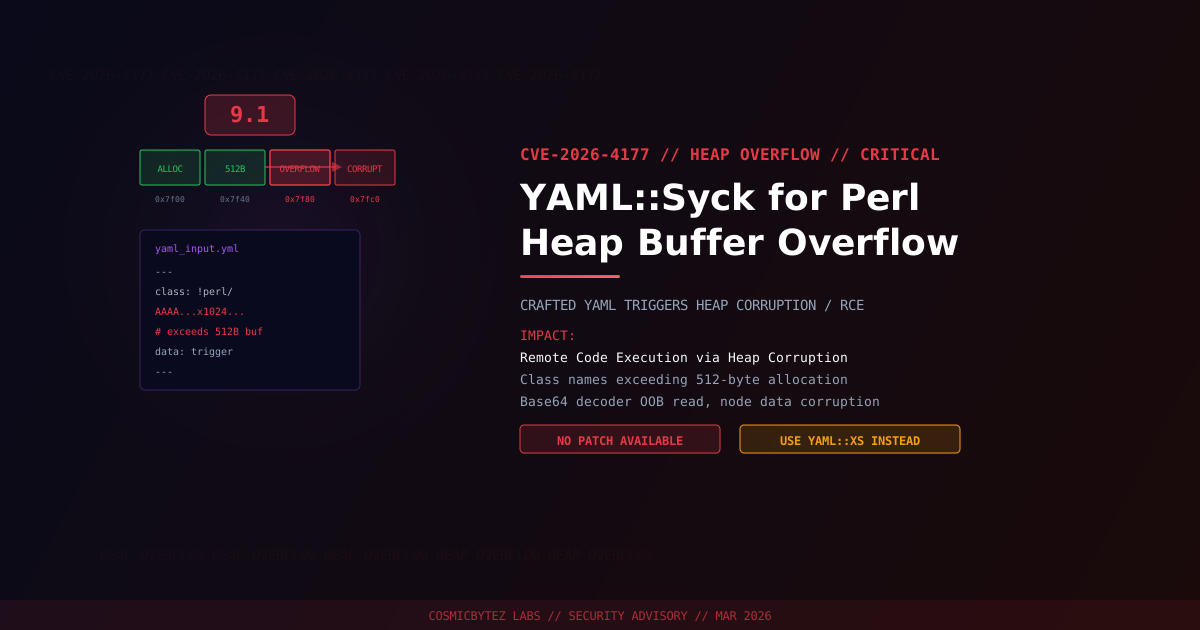
A critical heap buffer overflow vulnerability (CVE-2026-4177) has been disclosed in YAML::Syck, a widely-used Perl module for parsing and emitting YAML documents. The vulnerability carries a CVSS score of 9.1 and can be triggered by crafted YAML input that causes class names to exceed the initial 512-byte heap allocation in the YAML emitter, leading to heap corruption and potentially remote code execution.
CVSS Score: 9.1 (Critical)
The disclosure, published to the oss-security mailing list on March 16, 2026, identifies multiple security flaws in YAML::Syck through version 1.34, including the heap overflow, an out-of-bounds read in the base64 decoder, node data corruption via strtok, and a memory leak in anchor handling. No patch is currently available — the recommended mitigation is to migrate to YAML::XS as a drop-in alternative.
Vulnerability Overview
| Attribute | Value |
|---|---|
| CVE ID | CVE-2026-4177 |
| CVSS Score | 9.1 (Critical) |
| Type | CWE-122: Heap-based Buffer Overflow |
| Attack Vector | Network (via crafted YAML input) |
| Privileges Required | None |
| User Interaction | None (if YAML is parsed from untrusted sources) |
| Component | YAML emitter — class name serialization |
| Root Cause | Fixed 512-byte allocation overflowed by long class names |
Affected Versions
| Module | Affected Versions | Fixed Version |
|---|---|---|
| YAML::Syck (Perl) | <= 1.34 | None available (use YAML::XS) |
Multiple Vulnerabilities in YAML::Syck
The CVE-2026-4177 disclosure covers four distinct security flaws, all present in YAML::Syck through version 1.34:
1. Heap Buffer Overflow in YAML Emitter (Primary — Critical)
The YAML emitter allocates a fixed 512-byte buffer for class name serialization. When a YAML document contains a Perl blessed reference (!perl/) with a class name exceeding 512 bytes, the emitter writes past the end of the allocated buffer, corrupting adjacent heap memory.
# Vulnerable code path (simplified)
# Emitter allocates 512 bytes for class name
char class_buf[512];
# No bounds check — long class names overflow the buffer
strcpy(class_buf, node->type_id);This is a classic heap buffer overflow that can be weaponized for:
- Heap metadata corruption — overwrite malloc chunk headers to achieve arbitrary write
- Function pointer overwrite — redirect execution to attacker-controlled code
- Return-oriented programming (ROP) — chain existing code gadgets for arbitrary execution
2. Base64 Decoder Out-of-Bounds Read (High)
The base64 decoder in Syck's C library reads past the end of the input buffer when processing YAML values with trailing newlines in base64-encoded blocks. This can leak adjacent heap memory contents.
# Trigger: base64 value with trailing newline
data: !!binary |
  SGVsbG8gV29ybGQ=
3. Node Data Corruption via strtok (Medium)
The strtok() function is used to parse node->type_id, which mutates the string in place by inserting null bytes. Since type_id may be shared across multiple nodes, this corrupts node data for subsequent parsing operations, leading to unpredictable behavior.
4. Memory Leak in Anchor Handling (Low)
The syck_hdlr_add_anchor() function leaks the incoming anchor string when a node already has an anchor assigned. The early return path fails to free the allocated string, causing a memory leak that can be exploited for denial of service through repeated YAML parsing.
Attack Vector
Any application that parses untrusted YAML input using YAML::Syck is vulnerable. Common attack surfaces include:
1. Attacker crafts YAML document with class name exceeding 512 bytes
2. YAML document is submitted to a Perl application (web API, config parser, CI/CD pipeline)
3. Application calls YAML::Syck::Load() or YAML::Syck::Dump() on the input
4. Emitter writes class name past 512-byte buffer boundary
5. Adjacent heap memory is corrupted — malloc metadata, function pointers, or data structures
6. Attacker achieves code execution with the privileges of the Perl processReal-World Attack Surfaces
| Surface | Risk Level | Description |
|---|---|---|
| Web applications | High | Perl web apps accepting YAML uploads or API payloads |
| CI/CD pipelines | High | Build systems parsing YAML configs from repositories |
| Configuration management | Medium | Tools reading YAML config files from untrusted sources |
| Email processing | Medium | Perl scripts parsing YAML-formatted email content |
| CPAN module dependencies | High | Any Perl module that depends on YAML::Syck for deserialization |
Immediate Remediation
Option 1: Migrate to YAML::XS (Recommended)
YAML::XS is a maintained, security-audited alternative that provides a compatible API:
# Before (vulnerable)
use YAML::Syck;
my $data = YAML::Syck::Load($yaml_string);

# After (safe)
use YAML::XS;
my $data = YAML::XS::Load($yaml_string);# Install YAML::XS
cpanm YAML::XS
# Or via system package manager
apt install libyaml-libyaml-perl # Debian/Ubuntu
dnf install perl-YAML-LibYAML # RHEL/FedoraOption 2: Input Validation (Temporary)
If immediate migration is not possible, validate YAML input before parsing:
# Reject YAML with excessively long type tags
if ($yaml_string =~ /!\S{512,}/) {
    die "YAML input rejected: type tag exceeds safe length";
}
my $data = YAML::Syck::Load($yaml_string);Option 3: Sandboxed Parsing
Run YAML parsing in a restricted subprocess with resource limits:
# Use cgroups or containers to limit the blast radius
# Restrict memory, network, and filesystem access for the parsing processDetection Indicators
| Indicator | Description |
|---|---|
| YAML documents with class names > 512 bytes | Exploitation attempts targeting the heap overflow |
| Crash dumps from Perl processes with heap corruption | Successful or attempted exploitation |
| Unexpected base64-encoded payloads in YAML input | Targeting the base64 decoder OOB read |
| Memory growth in long-running Perl YAML parsers | Anchor handling memory leak being exploited |
| Segfaults in Syck C library functions | Heap corruption from overflow or strtok mutation |
Post-Remediation Steps
- Migrate all YAML::Syck usage to YAML::XS across the codebase
- Audit Perl dependencies — run
cpan-auditor checkcpanfilefor transitive YAML::Syck usage - Review application logs for crashes or unexpected behavior in YAML parsing code paths
- Update container images that bundle YAML::Syck in their Perl installations
- Scan CI/CD pipelines for YAML::Syck usage in build scripts and test harnesses
- Monitor for a patched release — the YAML::Syck maintainer may publish a fix to CPAN
References
- CVE-2026-4177: YAML::Syck heap buffer overflow — oss-security
- NVD — CVE-2026-4177
- YAML::Syck Perl Module: Critical Heap Overflow — TheHackerWire
- Server Security Alert: CVE-2026-4177 — BitNinja
- CVE-2026-4177 — THREATINT