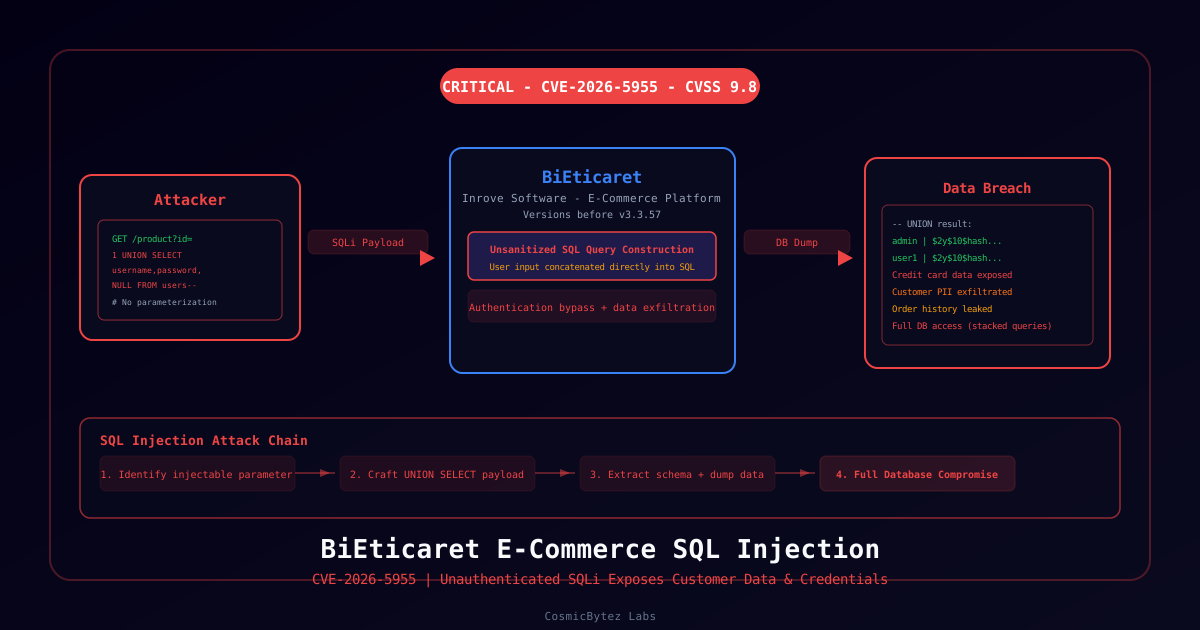
Executive Summary
CVE-2026-5955 is a critical SQL injection vulnerability in BiEticaret, an e-commerce platform developed by Inrove Software and Internet Services. All versions of BiEticaret before v3.3.57 are affected.
CVSS Score: 9.8 (Critical)
The vulnerability stems from improper neutralization of special elements in SQL commands — user-supplied input is concatenated directly into database queries without parameterization or escaping. An unauthenticated attacker can exploit this to extract the full database contents, bypass authentication, and potentially escalate to operating system command execution depending on database configuration.
For e-commerce platforms, the consequences are severe: customer payment data, order history, credentials, and PII are all at risk.
Vulnerability Overview
Root Cause
BiEticaret constructs SQL queries by directly concatenating user-supplied parameters (such as product IDs, search terms, or category filters) into query strings. This classic SQL injection pattern allows an attacker to append arbitrary SQL syntax — manipulating query logic, extracting data from other tables, or executing database commands.
Attack Vector
1. Attacker identifies an injectable parameter in the BiEticaret storefront
   (e.g., /product?id=1 or /category?cat=electronics)
2. Attacker injects a UNION SELECT payload:
   /product?id=1 UNION SELECT username,password_hash,email FROM users--
3. BiEticaret constructs the query without escaping:
   SELECT * FROM products WHERE id=1 UNION SELECT username,password_hash,email FROM users--
4. Database executes the combined query and returns user credentials
5. Attacker cracks password hashes offline or uses extracted session tokens
6. Full database access achieved — customer data, orders, payment info exfiltratedAuthentication Required?
No — the vulnerable parameters are typically present on public-facing storefront pages. No account or session is required to exploit the flaw.
Technical Details
CVSS Vector
CVSS:3.1/AV:N/AC:L/PR:N/UI:N/S:U/C:H/I:H/A:H
- Attack Vector: Network
- Attack Complexity: Low
- Privileges Required: None
- User Interaction: None
- Confidentiality / Integrity / Availability: High / High / High
Affected Versions
| Product | Vendor | Affected | Fixed |
|---|---|---|---|
| BiEticaret | Inrove Software and Internet Services | All versions before v3.3.57 | v3.3.57 |
SQL Injection Techniques Applicable
| Technique | Purpose | Risk |
|---|---|---|
| UNION-based | Extract data from other tables | Credential dump, PII |
| Error-based | Infer schema from DB error messages | Reconnaissance |
| Boolean-based blind | Infer data character by character | Full data extraction |
| Time-based blind | Confirm injection via response delay | Confirmation |
| Stacked queries | Execute multiple statements | Write files, call procedures |
Data at Risk
E-commerce platforms store particularly sensitive data. Exploitation of CVE-2026-5955 could expose:
| Data Category | Examples | Regulatory Impact |
|---|---|---|
| Payment data | Card numbers, expiry dates (if stored) | PCI DSS violation |
| Customer PII | Names, addresses, phone numbers, emails | GDPR / PIPEDA |
| Credentials | Username, password hashes | Account takeover |
| Order history | Purchase records, amounts, items | Business espionage |
| Admin accounts | Backend access credentials | Full platform compromise |
| API keys | Integration tokens (payment gateway, shipping) | Third-party breach |
Identifying Vulnerable Installations
Manual Testing
# Basic injection probe — single quote to break query syntax
curl "https://example.com/product?id=1'"

# UNION probe — determine number of columns
curl "https://example.com/product?id=1 ORDER BY 1--"
curl "https://example.com/product?id=1 ORDER BY 5--"

# If using sqlmap for authorized testing:
sqlmap -u "https://example.com/product?id=1" --dbs --batchNote: Only test against systems you own or have explicit written authorization to test.
Version Check
# Check BiEticaret version from admin panel or package files
grep -r "version" /path/to/bieticaret/config/ 2>/dev/nullRemediation
Update to v3.3.57 or Later (Required)
Apply the vendor's patch immediately. Version v3.3.57 addresses the SQL injection by implementing parameterized queries.
Contact Inrove Software support or check the BiEticaret release channel for the update package.
Developer Fix: Parameterized Queries
If you maintain custom BiEticaret code or cannot patch immediately, replace all dynamic query construction with parameterized queries:
// VULNERABLE (Do not use)
$id = $_GET['id'];
$query = "SELECT * FROM products WHERE id=" . $id;

// SECURE — Parameterized query with PDO
$stmt = $pdo->prepare("SELECT * FROM products WHERE id = :id");
$stmt->execute([':id' => $id]);
$result = $stmt->fetchAll();WAF Rules (Temporary Mitigation)
Deploy WAF rules to block common SQL injection patterns while patching:
# ModSecurity — block UNION SELECT attacks
SecRule ARGS "@detectSQLi" "id:1000,phase:2,deny,status:403,msg:'SQL Injection Detected'"

# Block common SQLi keywords in query parameters
SecRule ARGS "@rx (?i)(union\s+select|select\s+.*from|insert\s+into|drop\s+table|--\s*$)" \
    "id:1001,phase:2,deny,status:403"
Database Hardening
Reduce the blast radius of any successful SQL injection:
-- Create a restricted application user with minimal permissions
CREATE USER 'bieticaret_app'@'localhost' IDENTIFIED BY 'strong_password';
GRANT SELECT, INSERT, UPDATE ON bieticaret_db.* TO 'bieticaret_app'@'localhost';
-- Do NOT grant FILE, SUPER, or EXECUTE to the application userIncident Response
If you suspect exploitation has already occurred:
- Take the storefront offline temporarily to stop active exfiltration
- Review database access logs for unusual query patterns or large data reads
- Check web access logs for injection probes (
UNION,SELECT,ORDER BY N) - Rotate all credentials — database passwords, admin accounts, API keys
- Notify affected customers per applicable breach notification regulations (PIPEDA, GDPR)
- Engage a forensics firm if payment card data may have been accessed (PCI DSS requirement)
Log Analysis Query
# Look for SQL injection patterns in web logs
grep -i "union\|select.*from\|order by [0-9]\|'--\|1=1" /var/log/nginx/access.log

# Splunk query
index=web | where match(uri_query, "(?i)(union|select.*from|order by \d|--)")
| stats count by src_ip, uri_path | sort -countReferences
- NVD — CVE-2026-5955
- OWASP — SQL Injection
- OWASP — SQL Injection Prevention Cheat Sheet
- PCI DSS — Requirement 6.3 (Injection Flaws)