Executive Summary
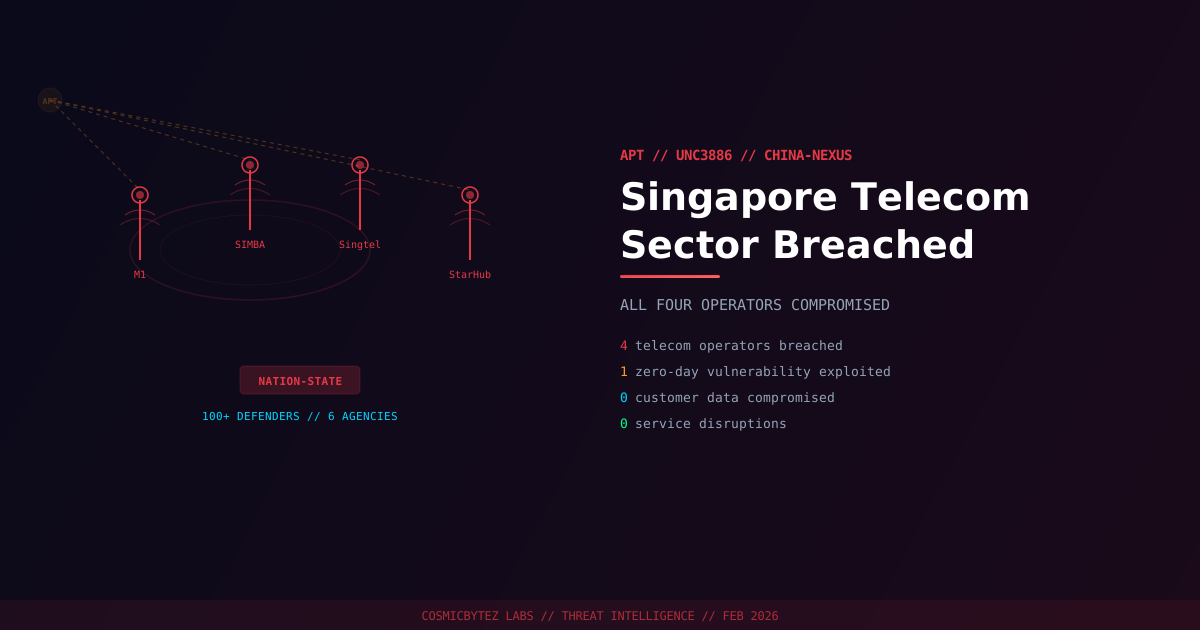
Singapore's Cyber Security Agency (CSA) has disclosed that all four of Singapore's major telecom operators — M1, SIMBA Telecom, Singtel, and StarHub — were breached by the China-linked espionage group UNC3886 in what officials called a "deliberate, targeted, and well-planned campaign."
The attackers exploited a previously unknown zero-day vulnerability to gain initial access. Over 100 cyber defenders from six government agencies responded in what Singapore described as its largest-ever multi-agency cyber operation.
Attack Overview
Timeline
| Phase | Details |
|---|---|
| Initial access | Zero-day exploitation of undisclosed vulnerability |
| Lateral movement | Targeted access across all four telecom networks |
| Data exfiltration | Small amount of technical/network-related data stolen |
| Detection | Identified through joint government-industry monitoring |
| Response | 100+ cyber defenders across 6 agencies mobilized |
| Disclosure | February 10, 2026 |
Impact Assessment
| Category | Status |
|---|---|
| Customer personal data | Not compromised |
| Service disruption | None — services remained operational |
| Data exfiltrated | Technical and network configuration data |
| Systems affected | Portions of telecom networks; limited access to critical systems in one case |
| Attribution | UNC3886 (China-nexus espionage group) via Mandiant/Google |
Who Is UNC3886?
UNC3886 is a China-nexus espionage group tracked by Mandiant (Google-owned) that has been active since at least 2021. The group specializes in targeting telecom, defense, and technology organizations across the United States and Asia-Pacific region.
Known Tactics and Capabilities
| Technique | Description |
|---|---|
| Zero-day exploitation | Regularly discovers and uses undisclosed vulnerabilities |
| Edge device targeting | Focuses on firewalls, VPN concentrators, and network appliances |
| Custom malware | Deploys bespoke backdoors tailored to target environments |
| Living-off-the-land | Extensive use of legitimate tools to avoid detection |
| Long-term persistence | Designed for sustained intelligence collection, not disruption |
| Hypervisor attacks | Previously observed targeting VMware ESXi and vCenter |
Previous UNC3886 Operations
| Target | Year | Method |
|---|---|---|
| US defense contractors | 2022-2023 | Fortinet zero-day (CVE-2022-41328) |
| VMware environments | 2023 | ESXi zero-day exploitation |
| US/Asia telecom operators | 2024 | Edge device compromise |
| Singapore telecom sector | 2025-2026 | Undisclosed zero-day |
Why Telecom Targeting Matters
Telecommunications networks are high-value intelligence targets because they provide:
Intelligence Value
- Call detail records (CDRs) — Who is communicating with whom, when, and from where
- SMS content and metadata — Message content and communication patterns
- Location data — Real-time and historical movement patterns of targets
- Network architecture — Understanding of national communications infrastructure
- Lawful intercept systems — Potential access to government surveillance capabilities
- Subscriber databases — Identity information linked to phone numbers
Strategic Value
Compromising all four operators in a single country provides near-complete visibility into a nation's telecommunications landscape. This level of access enables:
- Comprehensive signals intelligence across the entire population
- Identification of intelligence targets through communication pattern analysis
- Preparation for future operations using network architecture knowledge
- Disruption capability if the espionage campaign were to escalate
Singapore's Response
Multi-Agency Operation
Over 100 cyber defenders from six government agencies participated:
| Agency | Role |
|---|---|
| CSA (Cyber Security Agency) | Lead coordination and incident response |
| IMDA (Infocomm Media Development Authority) | Telecom sector oversight |
| CSIT (Centre for Strategic Infocomm Technologies) | Technical analysis |
| DIS (Digital and Intelligence Service) | Military cyber defense |
| GovTech | Government technology support |
| ISD (Internal Security Department) | Counter-intelligence |
This represents the largest coordinated cyber defense operation in Singapore's history.
Recommendations for Telecom and Critical Infrastructure
Immediate Actions
- Hunt for UNC3886 indicators across edge devices, especially firewalls and VPN appliances
- Audit zero-day patch status on all network appliances and update to latest firmware
- Review network segmentation between operational and management planes
- Inspect hypervisor environments for signs of compromise (UNC3886's known specialty)
- Enable enhanced logging on all edge devices and forward to SIEM
Strategic Measures
- Assume breach for any internet-facing network infrastructure
- Implement network detection for lateral movement between management and operational networks
- Deploy deception technology (honeypots) on network management segments
- Establish threat intelligence sharing with national cyber agencies and ISACs
- Conduct regular red team exercises simulating nation-state telecom targeting
Broader Context
This disclosure follows a pattern of escalating Chinese cyber espionage targeting telecommunications globally:
| Incident | Year | Scope |
|---|---|---|
| Salt Typhoon / US telco breach | 2024 | AT&T, Verizon, T-Mobile targeted |
| UNC3886 / Singapore telco breach | 2025-2026 | All four national operators breached |
| Ongoing telecom targeting | 2026 | CISA warns of continued edge device exploitation |
CISA's recent Binding Operational Directive 26-02 requiring federal agencies to remove end-of-support edge devices directly addresses the attack vector UNC3886 is known to exploit.
References
- CSA Singapore — UNC3886 Disclosure
- Mandiant — UNC3886 Threat Profile
- CISA — BOD 26-02 Edge Device Directive