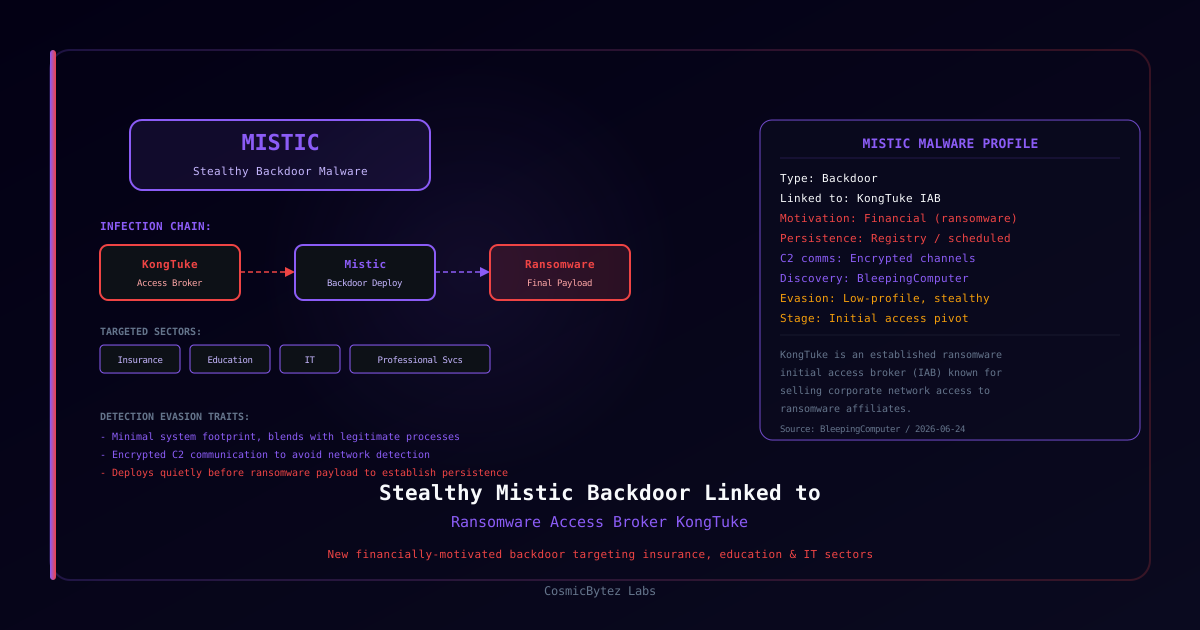
Security researchers have uncovered a previously undocumented backdoor malware family they are calling Mistic, deployed by the ransomware initial access broker KongTuke in ongoing attacks against organizations across multiple industries. The stealthy implant is designed to establish persistent access to compromised environments, providing KongTuke with long-term footholds that can be sold to ransomware affiliates or used to deploy ransomware directly.
The discovery was reported by BleepingComputer and represents a new tool in KongTuke's operational toolkit — signaling the group's continued investment in bespoke malware development to improve its access broker capabilities.
KongTuke: The Access Broker Behind the Attack
KongTuke is an established initial access broker (IAB) that specializes in infiltrating corporate networks and selling that access to ransomware operators. Operating in the financially motivated threat actor space, KongTuke:
- Gains initial access through phishing, exploitation of public-facing vulnerabilities, or credential abuse
- Establishes persistent footholds using loaders, remote access tools, and backdoors
- Sells verified network access on cybercriminal underground forums to ransomware affiliates
- Maintains access across multiple victim environments simultaneously
Prior research has linked KongTuke to Microsoft Teams-based phishing campaigns (reported in November 2025) and the deployment of commodity remote access tools. The introduction of Mistic — a purpose-built backdoor — represents an evolution toward more sophisticated, harder-to-detect tooling.
Initial Access Broker Ecosystem
KongTuke operates in a well-defined ransomware ecosystem supply chain:
[KongTuke] ──── Phishing / Exploitation ────► [Victim Network]
     │                                               │
     │         Mistic Backdoor Installed             │
     │                                               ▼
     └─── Sells Access ─────────────────► [Ransomware Affiliate]
                                                     │
                                              [Ransomware Deployed]
                                              [Data Exfiltrated]
By maintaining persistent Mistic implants across victim environments, KongTuke can offer "guaranteed access" to affiliates — a premium offering that commands higher prices on underground markets.
Mistic Backdoor Technical Analysis
Mistic is designed with stealth as its primary operational requirement. Researchers identified several characteristics that distinguish it from commodity remote access tools:
Core Capabilities
| Capability | Implementation |
|---|---|
| Remote code execution | Accepts and executes commands from C2 |
| File operations | Upload, download, and execute files |
| Persistence | Registry Run keys + scheduled task redundancy |
| Network comms | Encrypted C2 channel, mimics legitimate traffic |
| Process injection | Injects into legitimate Windows processes |
| Anti-analysis | Sandbox and VM detection |
Stealth Design
Mistic's stealth characteristics make it notably difficult to detect through conventional endpoint security:
Low system footprint: Mistic minimizes disk writes and avoids creating obviously malicious files. The primary payload may operate entirely in memory after initial execution.
Legitimate process masquerading: The backdoor injects into or spawns child processes of legitimate Windows system processes, making process-based detection unreliable.
Encrypted C2 communications: Command-and-control traffic is encrypted and may blend with legitimate HTTPS traffic patterns, evading network-based detection on its own.
Delayed activity: Mistic may remain dormant for extended periods before activating, making it harder to correlate the initial infection event with later malicious activity.
Persistence Mechanism
Registry: HKCU\Software\Microsoft\Windows\CurrentVersion\Run
Value:     [legitimate-sounding name]
Data:      [path to Mistic loader]

+ Scheduled Task: [runs on user login, mimics system task naming]
The dual-persistence mechanism ensures Mistic survives reboots and targeted cleanup of either persistence method alone.
Targeted Sectors
Researchers identified active Mistic campaigns across four primary sectors:
Insurance
Financial services companies — particularly insurance firms — are high-value targets for ransomware operators due to:
- Large repositories of sensitive customer PII
- Regulatory requirements that increase pressure to pay ransoms
- Interconnected systems with third-party partners amplifying breach impact
Education
Higher education institutions are perennially targeted due to:
- Distributed network environments with many devices and users
- Mix of personal and institutional systems without enterprise controls
- Student and faculty data with identity theft value
- Research data and grant funding making payment attractive
Information Technology
IT companies, MSPs, and service providers are targeted as "pivot points":
- Access to IT provider networks enables downstream attacks on clients
- IT system credentials often provide access to multiple downstream organizations
- Software build environments may enable supply chain attacks
Professional Services
Consulting, legal, and professional services firms are targeted for:
- Client data and confidential communications
- Business transaction data with financial leverage
- Regulatory obligations (attorney-client privilege, etc.) that complicate breach disclosure
Detection Guidance
Behavioral Indicators
# Check for suspicious scheduled tasks with system-like names
Get-ScheduledTask | Where-Object {
    $_.TaskPath -like "\Microsoft\Windows\*" -and
    $_.Actions.Execute -notlike "C:\Windows\System32\*"
}

# Review recently modified Run keys
Get-ItemProperty "HKCU:\Software\Microsoft\Windows\CurrentVersion\Run" |
    Select-Object * -ExcludeProperty PSPath, PSParentPath, PSChildName

# Check for process injection into legitimate processes
# (requires EDR telemetry — look for unusual children of svchost, explorer, etc.)Network Indicators
- Periodic beacon traffic (consistent intervals) to external IPs on port 443
- C2 domains may use DGA (domain generation algorithm) or fast-flux hosting
- Connections originating from unexpected processes (svchost connecting to external IPs)
EDR Telemetry Patterns
Organizations with endpoint detection and response (EDR) solutions should look for:
- Process injection events — code injected into
explorer.exe,svchost.exe, or other trusted Windows processes - Scheduled task creation via API calls from unexpected processes
- Registry modification in Run key locations outside of normal software installation
- Network connections from injected threads within legitimate process spaces
Response Recommendations
If Mistic Is Detected
- Isolate immediately — do not allow the compromised host to communicate with the network
- Assume complete compromise — treat all credentials cached on the system as compromised
- Search for lateral movement — KongTuke typically establishes multiple footholds before selling access; look for Mistic on other systems
- Rotate all credentials — VPN, domain accounts, service accounts, and any credentials stored in browsers or credential managers on the infected host
- Assume a buyer exists — KongTuke's model involves selling access. Even after cleanup, a ransomware affiliate may have already purchased and begun operating in the environment. Look for signs of reconnaissance: AD enumeration, network scanning, large file access events.
Proactive Hardening
- Enforce MFA on all remote access (VPN, RDP, SSO) — the primary initial access vector KongTuke exploits
- Restrict PowerShell execution — use Constrained Language Mode and AMSI logging
- Deploy application control (e.g., Windows Defender Application Control) to prevent unsigned executables
- Monitor scheduled tasks and Run keys — baseline and alert on unauthorized changes
- Segment networks — limit lateral movement capability if an initial compromise occurs
Broader Context: IAB Ecosystem Growth
The discovery of Mistic underscores the continued professionalization of the initial access broker market. IABs like KongTuke are investing in bespoke tooling — moving beyond commodity RATs and commodity malware — to:
- Improve evasion against EDR products that have learned to detect common tools
- Increase reliability of access across victim environments
- Differentiate their offerings in a competitive underground market
This professionalization mirrors trends in legitimate software development and signals that the threat from IABs is becoming more technically sophisticated even as law enforcement pressure increases.